
CBP wants the paperwork your factory filed in China. Can you get it?
Every container that leaves China leaves with a Chinese export declaration.
Someone filed it. Your factory. A trading company. A forwarder you've never met.
It shows a value. A quantity. A product code.
When did you last see yours?
CBP wants to know. On September 2 it published a notice asking whether importers should hand over the paperwork their suppliers filed with Chinese customs. Not your invoice. Theirs.
If the two don't match, CBP wants to know why. And it wants you to be the one who explains it.
What CBP published
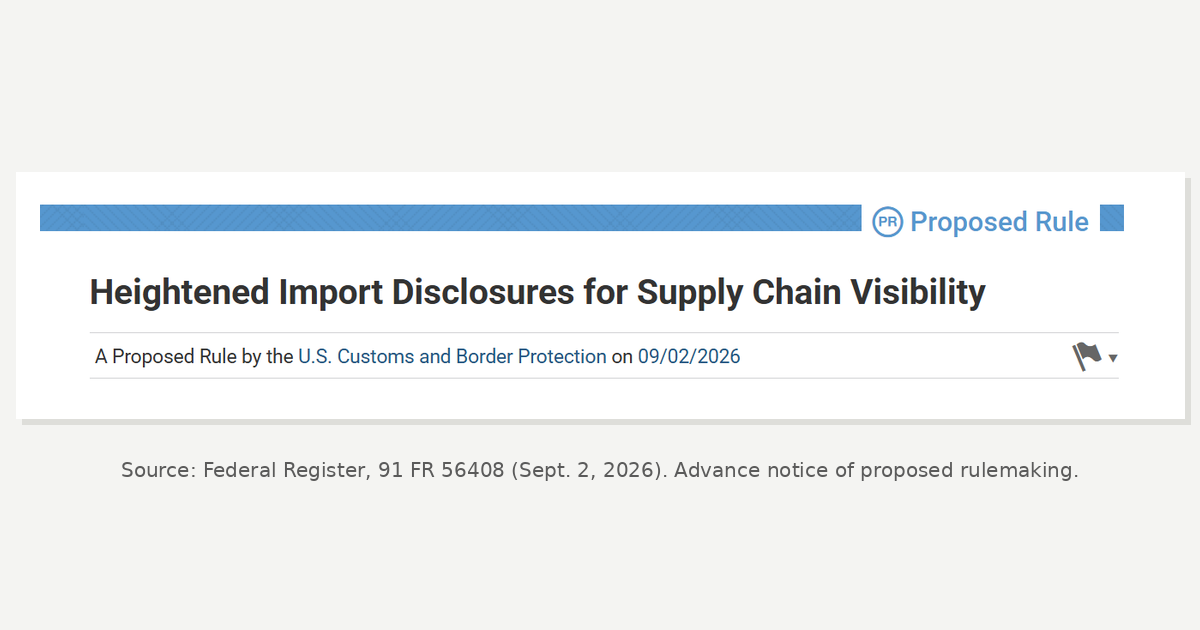
The notice is called Heightened Import Disclosures for Supply Chain Visibility (91 FR 56408, docket USCBP-2026-1058).
The Federal Register files it under "Proposed Rule". Read the first page and it's an earlier stage: an advance notice of proposed rulemaking. CBP is asking questions before it writes a rule.
So nothing changes tomorrow. But read the direction.
It comes straight out of Executive Order 14411, signed June 3, 2026. Section 3 of that order tells DHS to require foreign tax and business identifiers, detailed supply chain information, and any documents the foreign exporter had to give its own customs before shipping to the US.
CBP's stated target is illegal transshipment: goods routed through a third country to hide where they were really made.
Comments close December 1, 2026.
The three things CBP is considering
1. Your supplier's export paperwork. The documents filed with Chinese customs before the goods left:
- the export declaration, with declared value, product code and quantity
- the commercial invoice declared to Chinese customs
- the packing list
- the certificate of origin
- export licences, where needed
- the bill of lading or air waybill
CBP says what it's hunting for: dual invoicing. One price for Chinese customs. Another for American customs.
2. The real name of who made it. Today every entry carries a manufacturer ID code built from the name and address on the invoice. CBP admits it often doesn't point to the real party. It's looking at replacing it with full names and addresses of the manufacturer, shipper and exporter, or with global business identifiers like D-U-N-S or LEI. It's even asking whether to name the online marketplace that made the sale.
3. Tracing technology. CBP wants to use tracing tools, including AI, to spot transshipment before goods arrive. It asks what technology exists to verify where raw materials come from. And whether CTPAT members should be required to use it.
Read CBP's questions. That's where the real message is.
The notice asks 64 questions. Most are technical. A handful tell you exactly where this is going.
Q4. Should the importer of record be the one who keeps these records and hands them over when asked?
Q5. If the importer submits them, is "the duty of reasonable care an appropriate standard" for checking they're accurate?
Read that twice. CBP is asking whether you'll be responsible for the accuracy of a document your supplier filed, in Chinese, with Chinese customs.
Q11. If the export declaration shows a different value, quantity or product code from your US entry, how do you reconcile it, and what evidence explains the gap?
Q12. How do you prove the copy you hand over is the exact document filed, not one edited for you?
Q16. How long does it take to get these documents from your supplier?
Q17. What about documents that aren't in English?
Those aren't customs questions. They're factory questions. Who files your export declaration? Will they give you a copy? Is it the real one? Does it match what you paid?
"It's only proposed." Why waiting is a mistake.
Three reasons.
Reasonable care is already your duty. The DOJ and DHS said it plainly in their July 2026 trade fraud guide: the importer can't pass reasonable care to the broker or the supplier. If your supplier's declaration says one thing and your entry says another, that's your problem today, rule or no rule.
Suppliers don't hand over paperwork to strangers. If the rule lands and you've never asked for an export declaration, you'll be asking a factory boss you've met once, in a language you don't speak, for a document he's never shown a customer. That takes time. Trust takes longer.
You may learn something you don't like. Ask for the declaration and you may find the exporter isn't your factory at all. It's a trading company. Or the declared value isn't the price you paid. Better you find that out than CBP.
The executive order behind this notice also ordered a penalty floor of at least 50% and new rules for who can be an importer of record. The direction doesn't reverse.
What you can do this week. It costs nothing.
- Ask who files your export declaration. The factory, a trading company, or a forwarder. Write the name down.
- Ask for a copy from your last shipment. Chinese is fine. You want the original, not a summary.
- Compare three numbers. The value, the quantity and the product code against your commercial invoice and your US entry. Note every difference, even small ones.
- Check the name on your US entry. Is the manufacturer on your entry the company that actually made the goods?
- Keep it. Every document, every shipment, five years. That's already the US recordkeeping rule.
- Have your say. Comments close December 1. If getting these documents from China would be hard for you, tell CBP. Real experience from importers is exactly what CBP asked for.
If your supplier says yes, sends the declaration and the numbers match, good. You're ahead of most.
If not, keep reading.
Where we come in
Nobody in China works only for you. We do.
The factory works for the order. The trading company works for its margin. The forwarder works for whoever pays the freight. None of them will chase their own export declaration and check it against your invoice.
We will. It's what we already do for our monthly clients. Now it has a name: the Reasonable Care File. One file per supplier, built in the factories, owned by you. Who the supplier really is. What they can make. Where every material comes from. Every shipment traced, including the export declaration. Every change logged.
We don't get it by pushing. We get it over tea. Most suppliers are good. They just don't know what CBP wants from them. We help them get it right, and they hand over what a stranger never gets.
Two ways to have it:
- Monthly Support: our team builds and keeps your Reasonable Care File. From $995 a month.
- Employee in China: your own full-time person in China handles all your supply chain needs, and builds the Reasonable Care File with us. From $595 a month plus the person's salary.
Not ready for a monthly? Start with one supplier: a Factory Reality Check with the CBP Evidence Score.
More on the file: what's inside a Reasonable Care File.
FAQ
Is CBP now requiring importers to submit Chinese export declarations? No. The September 2, 2026 notice (91 FR 56408) is an advance notice of proposed rulemaking. CBP is collecting comments until December 1, 2026. Any requirement would come in a later proposed rule, then a final rule.
What foreign export documents is CBP considering? The export declaration filed with the foreign customs authority, the commercial invoice and packing list declared there, the certificate of origin, export licences or permits, and the transport document such as the bill of lading or air waybill.
Why does CBP want them? To compare what was declared at export with what was declared at US entry, and to detect dual invoicing and illegal transshipment.
Who would be responsible for the documents? CBP is asking whether it should be the importer of record, and whether the duty of reasonable care should apply to checking their accuracy.
What happens to the manufacturer ID code (MID)? CBP says the MID often fails to identify the real manufacturer. It is considering replacing or redefining it, possibly with full company details or global business identifiers such as D-U-N-S, GLN, LEI or Altana ID.
My supplier won't share its export declaration. What should I do? Find out who files it. If it's a trading company, the factory may never see it. Ask in Chinese, explain why, and keep a record of the request and the answer. A refusal is information too.
Does this apply to goods from Vietnam, India or Indonesia? The notice covers all goods imported into the United States. It was written with transshipment through third countries in mind.
How do I comment? Through regulations.gov, docket USCBP-2026-1058, before December 1, 2026. Comments are public.
China Agent Ltd. Not legal advice. We are not US trade counsel. The CBP notice is an advance notice of proposed rulemaking, not a final rule. Confirm how it applies to your goods with your customs broker or trade counsel.