
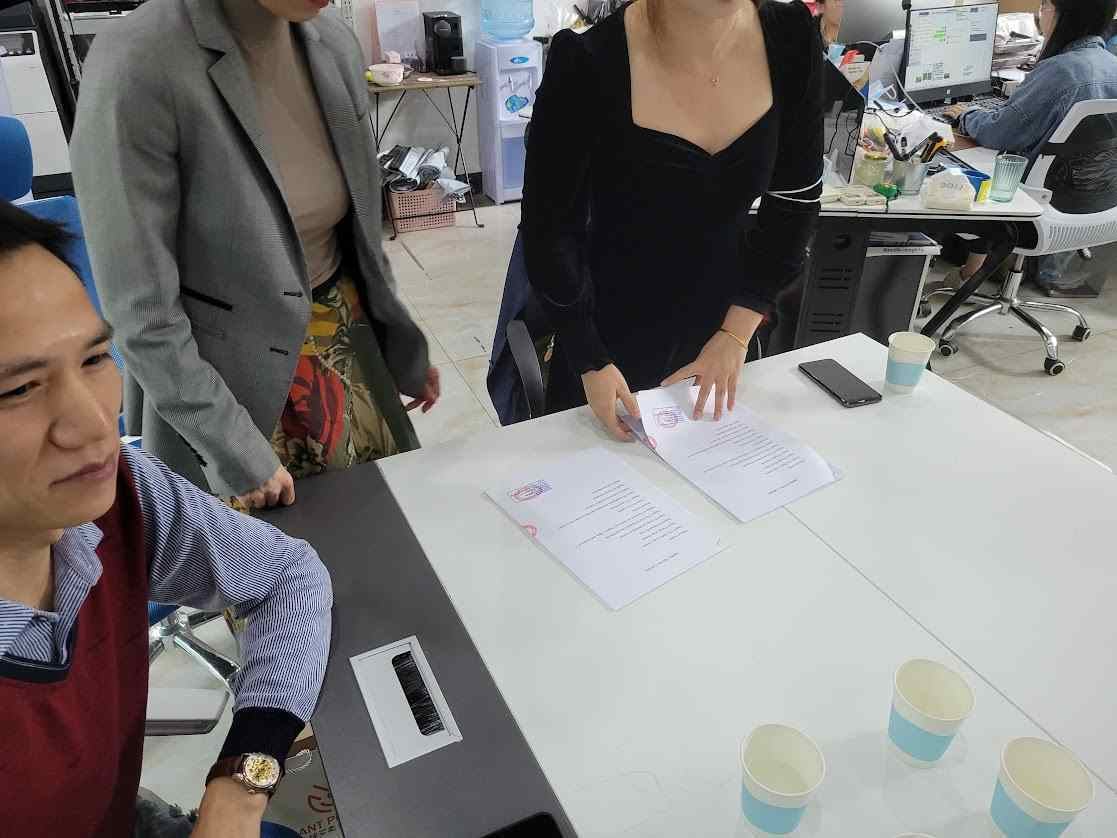
A contract that holds across every order. Not just the first one.
The $595 Purchase Order Contract protects a single order. The Sales Contract protects the relationship — every order, every shipment, every quality drift, every price renegotiation across a recurring supplier relationship.
Drafted in Chinese, by Chinese lawyers, under Chinese contract law, with the chop on the right legal entity and jurisdiction in the supplier's home province.
If you're about to commit to a recurring supplier — three orders, twelve orders, two years of production — this is the contract that survives the relationship.
#3 — Negotiation without a contract is just a conversation. In China, a polite one.
Polite conversations don't recover bad orders. Polite conversations don't enforce IP. Polite conversations don't get replied to once production is paid for.
The Sales Contract isn't bureaucracy. It's the single thing that converts trust into leverage when something goes wrong — across every order in the relationship, not just the first one.
What's included
A bilingual Master Sales Agreement with twelve enforceable layers. Drafted by Chinese lawyers. Signed and chopped in your supplier's home province.
1. Bilingual contract (English + Chinese)
English version for you. Chinese version for the factory. Chinese is the legally controlling text. If they conflict, the Chinese wins — which means the Chinese has to be right.
2. Drafted under Chinese contract law
Not a translated US or EU contract. A document drafted from the start under Chinese contract law, by Chinese lawyers, for Chinese courts.
3. NNN protection (Non-disclosure, Non-use, Non-circumvention)
Standard NDAs don't work in China. NNN does. Your designs, formulas, supplier list, and IP are protected against disclosure, unauthorized use, and circumvention — across every order in the relationship.
4. OEM provisions
Your IP stays yours. Tooling, samples, designs, and product specs remain your property — not the factory's. Critical when you scale orders across years.
5. Master pricing structure
Locked unit pricing or transparent adjustment mechanisms (e.g., raw material indexing). Protects you from quiet price creep across orders 2, 5, 10, 20.
6. Lead time + capacity commitments
The factory commits to specific production capacity for your account. If they take on a bigger client and try to push your orders to the back of the line, you have leverage.
7. Quality standards locked across orders
Quality specifications, AQL levels, defect tolerances — fixed across every PO under the master. Protects against quality drift between orders 1 and 5.
8. IP escalation clauses
Mold ownership, design rights, and sample IP terms. Critical for buyers who pay tooling costs (the factory will quietly claim ownership of paid-for molds without these clauses).
9. Termination + transition terms
What happens when the relationship ends — order completion, IP return, mold return, transition support. Protects you from a bad-breakup scenario where you can't move suppliers.
10. Chinese court jurisdiction
Filed in the supplier's home province (where the factory's assets actually live). Jurisdiction language Chinese courts will accept — not international arbitration clauses that are technically valid but practically unenforceable.
11. Chop + legal-entity verification
We verify that the chop matches the registered legal entity, signed by an authorized representative. Not the parent company. Not the trading company. Not the "sister office." The right chop on the right entity.
12. Two rounds of revision included
Most Sales Contracts require minor revisions during initial drafting. Two rounds included; further revisions billed at standard legal hourly rates.
Drafted by China Agent's legal partners in China. Reviewed and signed by China Agent Senior Management . Filed with chop verification at the supplier's registered office.
What happens after you book
Three to four weeks. Six steps. One signed, chopped, enforceable contract.
Day 0 — You book Pay $1,850. Submit supplier company name, registered address, bank details, your product specifications, and any specific commercial terms you've already agreed (pricing, MOQ, lead time, payment terms).
Day 0–3 — Pre-contract verification We confirm the supplier's legal entity, registered address, chop registration, and authorized representatives. Critical — the contract has to be signed by the correct entity. If a verification issue is discovered (wrong legal entity, mismatched chop), we flag it before drafting begins.
Day 3–10 — Drafting Chinese lawyers draft the contract in Chinese. We translate to English in parallel. Both versions reviewed by China Agent senior staff for commercial terms, legal protection, and jurisdiction logic.
Day 10–14 — Your review You receive both English and Chinese versions. Two rounds of revision included. We work with your home-country counsel if they want to review.
Day 14–21 — Supplier negotiation + chop We send to the supplier in Chinese. Most suppliers sign within 5–10 days. If pushback occurs (it sometimes does), we coordinate the negotiation in Chinese and report back to you. Final version is chopped and signed by the registered legal entity.
Day 21–28 — Delivery + activation Final chopped contract delivered as PDF. Hard copy retained at our China Hub Manager's office. Contract is now active and enforceable on the next PO you issue.
Most Sales Contracts complete in 3 weeks. Complex commercial terms or supplier negotiation push timelines to 4 weeks. We tell you the projected timeline at booking — no surprise delays.
WHO THIS IS FOR
The Sales Contract sits between the $595 PO Contract and the $2,650 Contract Manufacturing Agreement. Three buyer types consistently land here.
The scaling buyer. You've placed 1–2 orders with the same supplier. They went well. You're about to commit to ongoing production — quarterly orders, monthly orders, a multi-year relationship. The PO Contract is fine for one shipment; the Sales Contract protects you across the entire trajectory.
The brand-builder buyer. You're not just sourcing a product — you're building a private label, an SKU line, or a recurring-revenue business. Your suppliers are part of your supply chain identity. The Sales Contract locks IP, mold ownership, design rights, and exclusivity options as you scale.
The risk-aware buyer. You've watched a previous supplier relationship drift — quality slipping, prices creeping, communication slowing — and you don't want to repeat it. The Sales Contract sets terms before drift starts. Most quality drift, price creep, and capacity squeeze happens because no master document said it couldn't.
What this looks like in practice
A real Sales Contract that closed three quiet leakage points before they cost the buyer real money.
"The factory was right. The contract said nothing about it. So they could keep doing it."
A US wellness brand had been ordering from a Chinese supplement-packaging supplier for fourteen months. Eight POs. Roughly $340,000 in annual production. Good relationship, on paper.
The buyer came to us to set up a Sales Contract before scaling to a private-label launch.
In the pre-contract verification, we noticed three issues that hadn't been visible during PO-by-PO ordering:
1. Custom mold ownership. The buyer had paid $11,400 in tooling costs for proprietary bottle shapes. There was no written agreement that the molds belonged to the buyer. The factory considered them factory property — and were quietly using the same molds for two competing brands they also supplied. The buyer never knew.
2. Quiet price creep. Across the eight POs, unit cost had risen 12% with no formal notification. Each PO was negotiated separately. The factory was right — there was no contract clause locking unit price. So they could raise it.
3. No NNN. The buyer's product formula was in WeChat messages. The factory had every ingredient, every supplier, every spec. With no NNN, this was usable IP for the factory to reproduce, modify, or quietly pitch to a competitor.
We drafted the Sales Contract with three locked clauses: mold ownership reverting to buyer; unit pricing locked with raw-material indexing only; full NNN with 5-year tail.
The factory pushed back on the mold ownership clause for three days. Then they signed.
Six months later: the buyer caught the same factory using their molds again — but this time, with a chopped contract specifying buyer ownership, a single email recovered $26,000 in damages and shut the misuse down within 14 days.
Sales Contract case · Zhejiang, 2024
What this isn't
Three things the Sales Contract is not — and what you should use instead.
Not a single-order contract.
If you're protecting one shipment or one trial order, the $595 Purchase Order Contract is the right tier. The Sales Contract assumes a recurring relationship. Don't pay for relationship-grade protection on a one-off order.
Not a manufacturing partnership agreement.
If the factory is dedicating production lines to your brand, building proprietary tooling at scale, or operating as your manufacturer-of-record, the $2,650 Contract Manufacturing Agreement covers terms the Sales Contract doesn't (line allocation, dedicated capacity, raw material sourcing, exclusivity).
Not active enforcement.
The Sales Contract creates the legal infrastructure for enforcement — but enforcement itself (active disputes, court filings, on-site negotiation when something has already broken) is the Fixer service. Contracts prevent. Fixer recovers.
Frequently asked questions
Common questions before buyers commit. If yours isn't here, ask.
A PO Contract covers a single purchase order — one shipment, one invoice, one production run. The Sales Contract covers a recurring relationship across multiple orders, with master pricing structures, quality commitments, and IP terms that persist between orders. If you'll order from this factory more than 2–3 times, the Sales Contract pays for itself.
Two options. Option A: we replace it. We draft a new Sales Contract under our framework, the supplier signs and chops, and the new contract supersedes the old one. Option B: we draft the Sales Contract as a supplement that overrides specific clauses in the existing contract. We typically recommend Option A — most existing buyer-side contracts are unenforceable in Chinese courts anyway.
No. We coordinate signing remotely — you sign and chop your version, we coordinate the factory's signing in person, and we verify the chop matches the registered entity. No flights required. (If you're already planning a Guided Visit, signing in person can be coordinated as part of the trip.)
Then they're telling you something. Most factories sign within 5–10 days. Pushback usually focuses on specific clauses (mold ownership, NNN, jurisdiction) — those negotiations are normal and we coordinate them in Chinese. If the supplier refuses to sign anything Chinese-law-enforceable, you have a different supplier problem, and we'd recommend due diligence before continuing the relationship.
Yes — we encourage it. Your home-country counsel is excellent at home-country contracts. They'll typically catch commercial terms specific to your market (consumer protection, returns, labeling). The legal framework itself stays Chinese-law because that's where enforcement actually lives.
A chop is the official company seal in China — a red ink stamp registered with the government. A signature alone is often not legally binding for a Chinese company. The chop is what makes a contract enforceable. We verify the chop matches the legal entity (not the parent, not the trading company, not the "sister office").
Two rounds of revision are included with the contract. Beyond that, contract amendments are billed at standard legal hourly rates. We recommend revisiting the Sales Contract every 18–24 months as the relationship matures, especially when product lines expand or pricing structures change.
Yes. If you've upgraded from either earlier service within 30 days of the original purchase, the previous fee credits toward the Sales Contract. Stack the system: $95 verifies the entity, $795 verifies the building, $1,850 protects the relationship.
A handshake is a memory. A contract is leverage.
The Sales Contract is the difference between hoping the factory keeps their word — and knowing that if they don't, you have somewhere to stand.
Includes everything in the $595 PO Contract structure, plus master agreement protections across all future orders.
The China Sales Contract is drafted by China Agent's legal partners in China — Chinese-licensed lawyers with manufacturing-sector specialization. Reviewed and signed by Eldad Shashua. Chop verification conducted on-site at the supplier's registered office. Trademark Verify. Visit. Secure.™ belongs to China Agent Ltd, registered 2016. Talk to Eldad directly: LinkedIn