
Short answer: It is stressful, but it is manageable. Two agencies are asking two questions about the same product. Don't move fast in the first three days. Collect both notices, get the real facts from the factory in China, put them on one page, and let your FDA counsel and your customs counsel decide the order together. Most of the facts both agencies want were written in China, long before the container sailed.
Two agencies, two questions, one product
Your container is sitting at the port. One notice comes from CBP. Another comes from FDA. It feels like the whole system has turned against you. It hasn't.
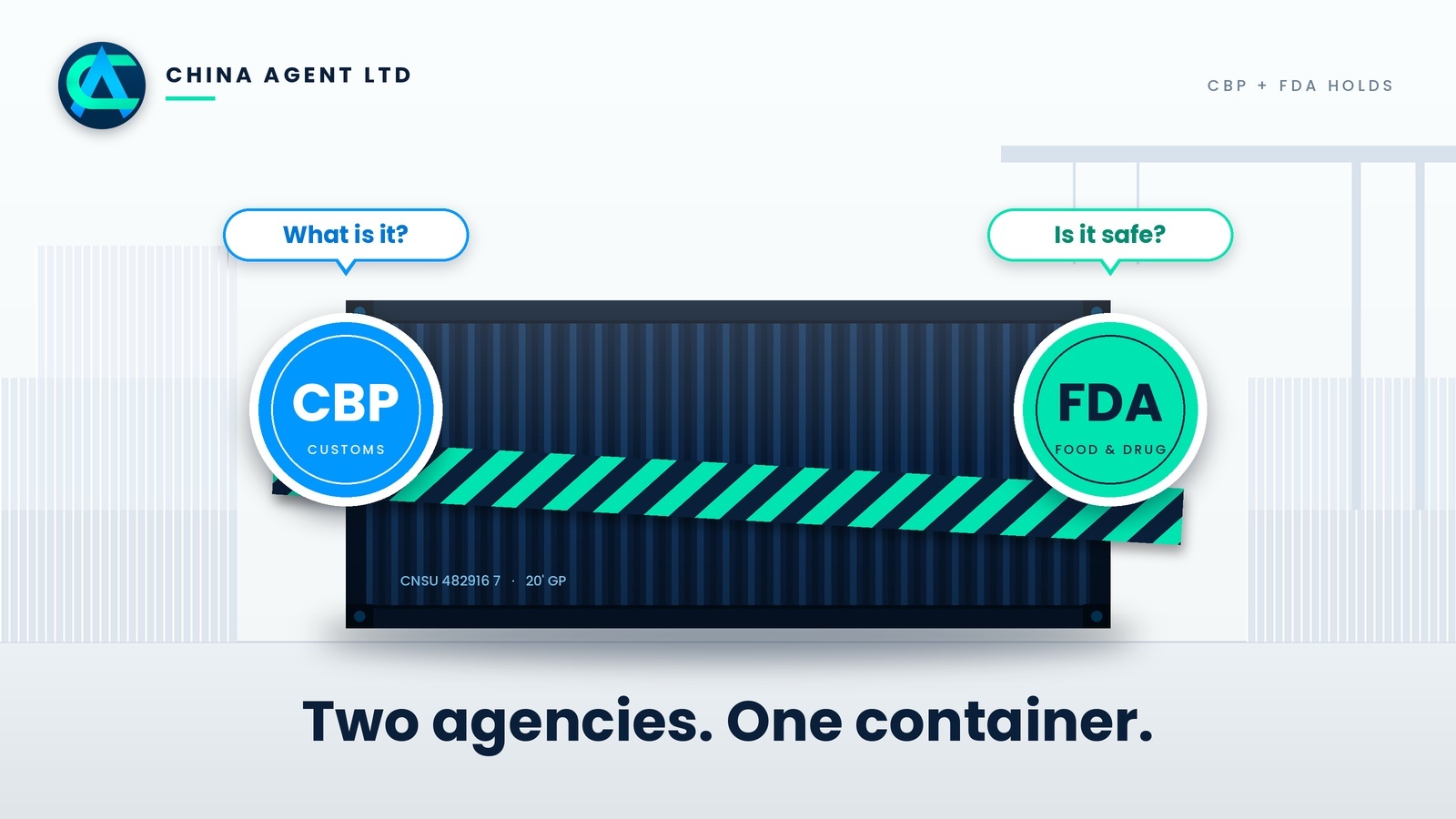
CBP's question is about what the product is for tariff and customs purposes. The tariff classification (the HTS code) decides the duty you pay and which rules apply. CBP holds goods when the description, value or classification doesn't add up.
FDA's question is about whether the product is safe and allowed in. FDA screens FDA-regulated entries with a system called PREDICT. A prior refusal on the manufacturer's record, or a factory listed on an import alert, can put a shipment on hold for exam. (FDA entry screening)
These rules exist for real reasons. CBP collects duty and stops goods that are misdescribed. FDA keeps unsafe food, drugs, devices and cosmetics off US shelves. Neither agency is out to get you.
Here is the catch. Both questions turn on the same facts. Is it a food, a supplement, a drug, a cosmetic or a device? The answer drives the FDA product code and it drives the HTS code. So fixing one agency in isolation can make the other one worse. Change the description to satisfy CBP and you may have just changed what FDA thinks the product is.
And re-exporting does not wipe the slate clean. FDA keeps its record on the manufacturer, not on your purchase order.
What it looks like from inside the factories
Most Chinese suppliers are good. Most shipments clear without trouble. When a hold does land, it is usually a paperwork story that started in China. Here is what we tend to look for on the client side when the records are missing or don't match:
- Three names, one factory. The trading company on the invoice, the factory on the business license, and the name FDA has on file are not the same. If you don't know which factory really made the goods, you can't tell what FDA record you inherited.
- No FEI, or the wrong one. The FDA facility number (FEI) and registration point to a different address or a different company.
- The label says more than you think. A health claim on an insert can turn a food into a supplement question, or a cosmetic into a drug question.
- Spec sheet and invoice tell a different story than the label. The spec sheet and invoice wording drive the HTS code. The label drives the FDA category. Nobody compared them.
- Quiet changes. A new sub-supplier, a new production line or a reprinted label between orders, and nobody told you.
- Nobody checked the full file before sailing. The factory, forwarder, broker and US files were never put side by side.
None of this means anyone lied. It usually means nobody in China was working for you when the papers were written.
A calm path for the first 72 hours
This is the order we follow with clients. Legal strategy belongs to your counsel or a trade lawyer. Our job is to get the facts out of China and put them in order.
Hours 0 to 12: collect everything. Get both notices, the entry data, the commercial invoice, packing list and any FDA paperwork. Don't refile, cancel or re-export yet.
Hours 12 to 36: get the China-side facts. Who really made the goods. The FEI and registration. The formula or bill of materials. The labels and inserts as printed. Test reports. Any changes since the last order. This is where people in China make the difference, because the factory has to be asked, in Chinese, by someone who knows what to ask for.
Hours 36 to 60: one page. Both holds, both codes, the maker's FDA history, prior entries and how they were classified, and any open IEEPA refund items on the same product. One page your counsel can read in five minutes.
Hours 60 to 72: counsel decides the order. Your FDA counsel and your customs counsel look at the same page and decide which agency to answer first and how. Track storage costs while they do.
After the release (or the refusal): fix the root cause with the factory, keep the records, and if the maker is on an import alert, counsel can use the evidence for a petition to remove it. (FDA: removal from DWPE)
A note on timing, kept small and factual: refused goods have to be exported or destroyed within 90 days, under CBP and FDA supervision. (FDA import refusals) Storage keeps running the whole time, which is one more reason to map before you move.
What it costs, honestly
Sorting out a hold costs money. Storage, counsel, and the work in China all cost something, and we won't pretend otherwise. What we can say is that working from one set of facts is usually cheaper than fixing the wrong agency first and then fixing it again.
Where we come in
We are not a law firm and we don't file entries. Your broker files. You, the importer, certify. Counsel or a trade lawyer handles every legal question. We verify the factory, gather and prepare the China-side file, and put it in front of the people making the decisions.
- If you're holding goods now and need to know who really made them: start with our Deep Dive Legal verification, from $995. It confirms the maker's identity and its FDA record and history, with a final memo reviewed by our legal partner.
- If you need the whole China-side file built for counsel: our CBP Documentation Rescue A-to-Z package, $4,995, now covers FDA holds too. We collect the factory facts and build the one-page map for your FDA and customs counsel.
Before the next order, two short reads help: the China product categories most exposed to FDA holds and the documents to get from your factory before you ship.
If a container is sitting at the port right now, book a free 30-minute call. We'll tell you what we'd collect first.
China Agent has worked on the client side in China since 2009. Today it is a Hong Kong company with people in Guangzhou, Foshan, Yiwu, Shenzhen and Jinan. China Agent is not a law firm and does not file customs entries. Legal questions go to counsel or a trade lawyer.