
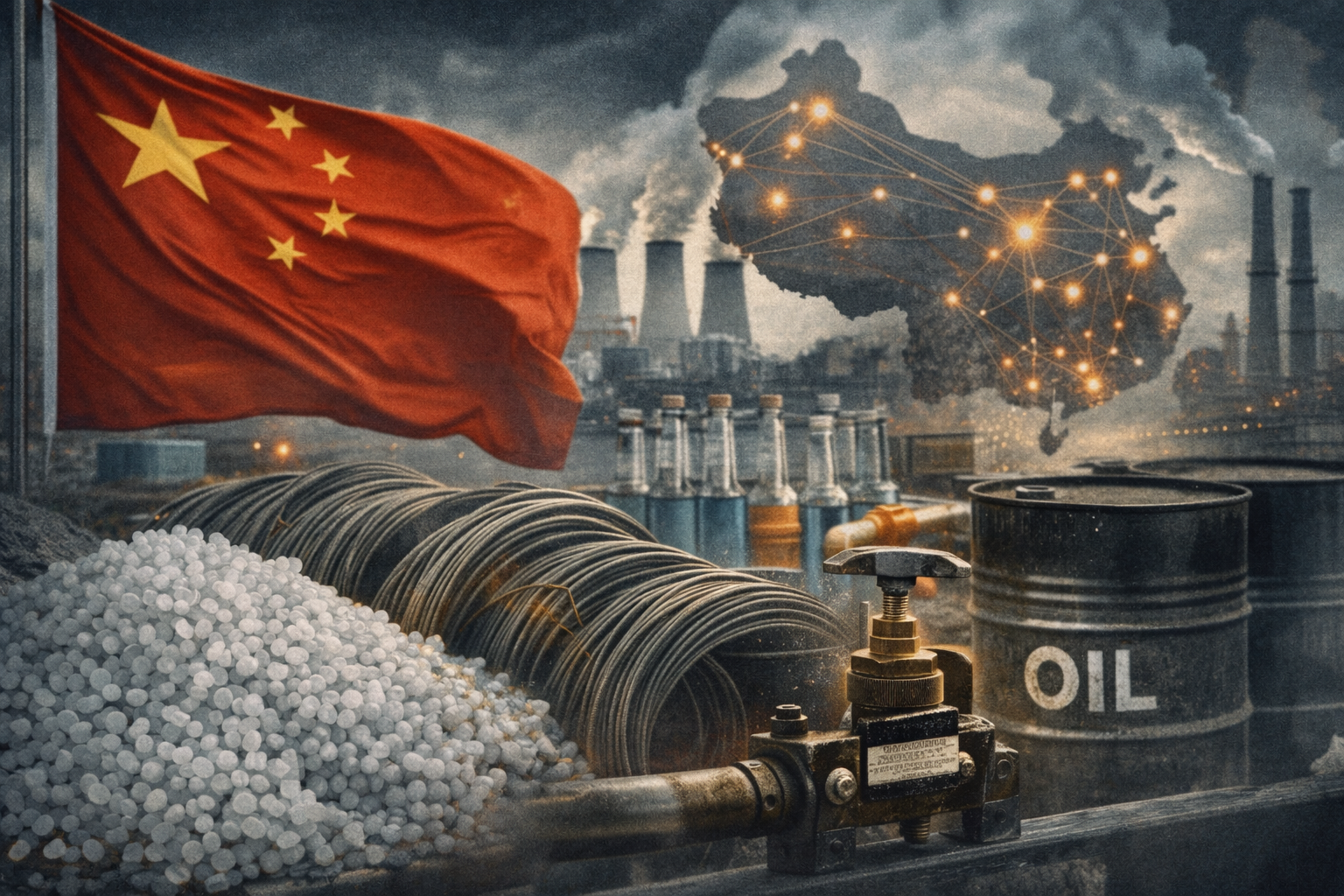

China Is Moving Upstream — And That Changes Everything
April 2026
China Agent Ltd.
For years, buyers understood China in one way:
China makes products.
That model is outdated.
China is no longer just producing goods.
It is increasingly controlling what production depends on.
And that changes how supply chains behave.
The shift most buyers are missing
From the outside, China still looks the same:
- factories running
- exports strong
- suppliers quoting
So buyers assume nothing changed.
But the shift is not in finished goods.
It’s upstream.
What “moving upstream” actually means
China is strengthening its position in:
- raw materials
- chemicals
- petrochemicals
- intermediate goods
- energy-linked production
These are not end products.
They are inputs.
And inputs control everything that comes after.
Why this matters more than manufacturing
Manufacturing is visible.
Inputs are not.
If a factory delays production, buyers see it.
If a material becomes unstable, buyers feel it later.
That delay is where risk builds.
Why China is doing this
This is not about exports.
It’s about control.
When global conditions become unstable, governments prioritize:
- domestic supply
- price stability
- strategic industries
Exporting finished goods is flexible.
Controlling inputs is power.
What this changes for global supply chains
Many buyers think they diversified away from China.
They didn’t.
They moved one layer away.
Today, a typical supply chain looks like:
China → inputs
Vietnam → assembly
EU / U.S. → consumption
China is still inside the system.
Just less visible.
The illusion of “leaving China”
Buyers say:
“We moved to Vietnam.”
But:
- materials still come from China
- components still come from China
- processes still depend on China
So when China adjusts upstream:
The entire chain adjusts.
How this shows up in real operations
Not through announcements.
Through behavior.
- material availability becomes uncertain
- pricing becomes unstable
- suppliers hedge commitments
- production planning loosens
- substitution risk increases
Nothing breaks immediately.
But everything becomes less predictable.
Why this is happening now
Because multiple pressures are aligning:
- energy disruptions
- geopolitical risk
- global trade reconfiguration
- domestic stability priorities
This pushes China to secure control where it matters most.
Upstream.
Where supply chains become exposed
Not at the factory.
Not at shipment.
But at:
- material sourcing
- supplier dependencies
- input allocation
This is where buyers have the least visibility.
And where risk is highest.
The compliance layer
This shift also affects compliance.
Because:
- origin becomes harder to define
- value becomes harder to justify
- documentation becomes harder to align
If materials move across borders before production, the story becomes more complex.
And complexity creates exposure.
The buyer mistake
Most buyers still focus on:
- unit price
- lead time
- finished goods inspection
This is downstream thinking.
It ignores where control has moved.
Upstream.
What smart importers are doing
They are adjusting their model:
- mapping upstream suppliers
- verifying material sources
- understanding dependency chains
- locking inputs early
- reducing reliance on assumptions
They don’t just manage suppliers.
They manage supply chains.
China Agent framework
This is where structure matters.
We focus on:
1) Upstream mapping
- material origin
- supplier layers
- dependency points
2) Input verification
- availability
- allocation
- stability
3) Production alignment
- matching materials to output
- preventing substitution
- verifying execution
4) Documentation consistency
- aligning declared origin with reality
- ensuring value logic holds
5) Continuous oversight
- tracking changes
- detecting drift early
- correcting before shipment
Perspective
China is not stepping back.
It is repositioning.
From:
- making products
To:
- controlling what products depend on
That is a stronger position.
Final thought
Supply chains are not becoming simpler.
They are becoming more layered.
And in layered systems, control sits upstream.
Buyers who understand this will adapt.
Buyers who don’t will keep solving problems too late.
FAQ
1) Is China reducing exports?
Not broadly. It is controlling key upstream areas.
2) What does “upstream” mean?
Materials, inputs, and intermediate goods.
3) Does this affect Vietnam and ASEAN?
Yes. They depend heavily on China for inputs.
4) Why is this happening now?
Energy pressure, geopolitics, and domestic priorities.
5) What is the biggest risk for importers?
Lack of visibility into material sourcing.
6) Will this increase prices?
Gradually and often indirectly.
7) Why don’t suppliers explain this?
Because they adjust behavior instead of explaining constraints.
8) Is diversification still useful?
Yes, but it does not remove upstream dependency.
9) What should buyers verify first?
Material origin and supplier dependencies.
10) What is the key shift?
From supplier management to supply chain control.