


Last month, I stood on a dusty factory floor in Ningbo while a manager explained why a 12% rejection rate was "normal" for a first run. My client was thousands of miles away, staring at an inbox full of empty promises. This is the reality of trying to fix problems with a Chinese supplier through a screen. You send an urgent email. They send a vague apology. Nothing changes. Usually, the silent treatment starts exactly when your production deadline hits a wall.
You probably feel the same frustration. You've seen the quality fade or the sudden price increases that happen once your deposit is gone. It's a high-stakes game where digital communication is often a weakness. This article delivers a blunt strategy for 2026. I'll explain how physical on-site intervention resolves manufacturing disputes and recovers lost funds. We'll look at where the relationship broke down and build a plan to keep your interests protected under the new State Council Order No. 834 regulations. It's time to stop hoping for a reply and start demanding results.
Key Takeaways
- Emails don't solve manufacturing crises. Learn why your supplier likely understands your requests perfectly but chooses to ignore them until you show up in person.
- Discover how a physical audit in Ningbo exposed a secret subcontracting scheme that nearly cost a client $50,000 in defective inventory.
- Move beyond digital requests and use a "fixer" approach to fix problems with chinese supplier relationships by auditing business licenses against actual floor operations.
- Stop being a victim of "hostage" molds and fake material cost increases by separating factory excuses from the ground-truth reality of their production line.
- Build a 2026 strategy that replaces hope with hard data through Due Diligence reports and consistent Monthly Support.
Why 'Better Communication' Won't Fix Problems with Chinese Suppliers
I once watched a buyer send 14 emails over three weeks trying to "clarify" a color mismatch. The factory manager read every single one. He didn't reply because he knew the buyer was stuck in a home office 5,000 miles away. He wasn't confused. He was waiting for the buyer to accept the mistake and pay the balance. This is why "better communication" is a myth. To fix problems with chinese supplier contracts, you don't need a better translator. You need a physical presence.
Suppliers understand your requirements perfectly. They choose not to act because digital distance removes accountability. If you are just a notification on a smartphone, you are easy to ignore. A "fixer" approach moves the conversation from the inbox to the factory gate. It replaces polite requests with physical verification. When a factory realizes you have no eyes on the ground, problems escalate. They know you can't prove who is at fault from a desk in Europe or America.
Most sourcing agents won't help you here. They often survive on hidden factory commissions. They want the relationship to stay "polite" so their kickbacks keep flowing. An independent fixer has no such conflict. Their only job is to protect your interests and ensure effective supply chain management by identifying the ground-truth reality. This is the difference between someone who wants to close a deal and someone who wants to protect your capital.
The Illusion of the Gold Supplier Status
Don't trust a digital badge. Alibaba rankings and "verified" profiles are marketing products, not quality guarantees. I have seen "Gold Suppliers" that were nothing more than three people in a rented office subcontracting work to unverified workshops. When quality fades, these digital credentials won't help you. A Due Diligence report is the only way to see past the verified profile and onto the actual factory floor. Digital distance is a tool they use to hide the truth.
Leverage vs. Politeness
Western business culture prizes politeness. In a Chinese manufacturing dispute, "please" and "thank you" are often interpreted as a lack of leverage. If you are being polite while your production is three weeks late, you are telling the supplier they can prioritize other clients first. Leverage is physical. It comes from having eyes on the ground that can perform a Supplier Reality Check™. You shift the power dynamic by showing the factory that you are watching the line, not just waiting for an email. Real leverage is the ability to walk into their office and demand to see the production schedule. That is how you actually fix problems with chinese supplier delays.
Case Study: Resolving a $50,000 Quality Dispute in Ningbo
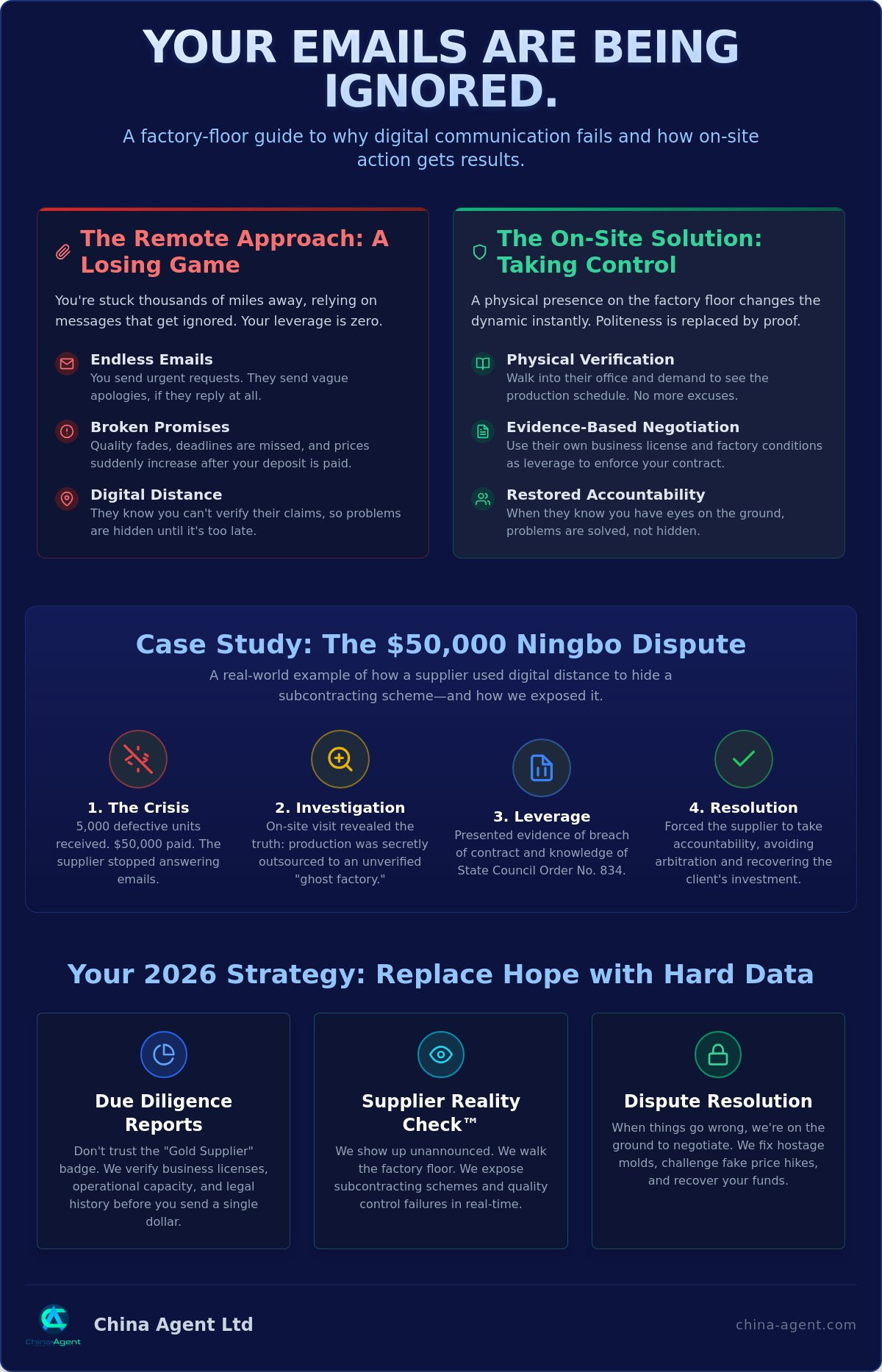
I got a call from a New York buyer who was staring at 5,000 defective units. He had paid $50,000. The factory in Ningbo had stopped answering his emails three days after the final payment cleared. This is the standard "ghosting" phase. To fix problems with chinese supplier contracts, you can't rely on the same platform that sold you the goods. I drove to the facility address listed on their business license to see why the quality had collapsed so fast.
The Subcontracting Trap
When I arrived, the main assembly line was busy. It was producing high-end electronics for a European brand. My client's cheap plastic components were nowhere to be found. I pushed through the back office and found the truth. The factory owner had taken the $50,000, skimmed a massive margin, and outsourced the actual production to a small, unverified workshop three blocks away. This is the "ghost factory" trap. Suppliers hide where goods are made to cut costs. It creates a massive legal risk. Under Chinese law, unauthorized subcontracting is a clear breach of manufacturing agreements. It can even lead to the loss of export licenses if the "ghost" facility violates local environmental or labor standards.
Negotiating at the Factory Gate
I sat in the owner’s office. I didn't ask for a refund. I presented his own business license and the evidence of the subcontracted workshop. I reminded him that under State Council Order No. 834, mismanaged supply chain decisions can now be flagged as national security issues. I mentioned that while we could pursue formal dispute resolution through arbitration, it would be faster for him to fix the mess. We reviewed the Supplier Reality Check™ we had on file. The "non-refundable" policy he’d mentioned in emails vanished instantly. Physical presence ends the ghosting cycle because it removes the supplier’s ability to hide behind a screen.
The result was a full replacement of the batch. He pulled the job back to his main line and assigned his best QC lead to the project. The client had new, verified units in 14 days. This only happened because someone was physically at the gate. If you are currently hitting a wall of silence, our Fixer Service is designed to fix problems with chinese supplier relationships by putting a professional on the factory floor immediately.
The 4 Pillars of a Successful Chinese Factory Negotiation Service
I see advice on forums telling buyers to just "cut their losses" when a supplier goes dark. That is lazy advice. You can recover your investment, but you won't do it from a keyboard. To fix problems with chinese supplier disputes, you need a framework that applies pressure where it actually hurts: their local legal standing and their physical operations. I use four specific pillars to force a resolution.
- Physical Verification: I go to the factory. You cannot fix a production error if you are looking at a staged photo. I need to see the scrap pile and the raw material invoices.
- Document Audit: I compare the official government records to what the sales rep told you. Discrepancies here are your biggest leverage.
- Contractual Pressure: I use bilingual agreements that work in Chinese courts. If a contract isn't enforceable in the factory's home district, it doesn't exist.
- Local Presence: I speak the language of the shop floor. Factory owners respect people who know the price of steel in Hebei and the cost of labor in Guangdong.
The Power of the Business License
Checking the "Business Scope" on a license is my first step in every investigation. I once found a "factory" producing high-end valves whose license was only for "office furniture trading." They were illegal middlemen. If your supplier has no legal right to export the specific goods you ordered, they are vulnerable. I use this as a primary tool to fix problems with chinese supplier disputes. You can learn how to verify these details yourself with a China Export License Check. It reveals the physical truth behind the paper.
Bilingual Enforcement
Your US-based contract is a paper tiger. It is a document designed for a legal system the supplier doesn't fear. To get results, you need NNN and OEM agreements. These must be bilingual and governed by Chinese law. When I lead a Fixer Service mission, I bring these contracts to the table. I don't talk about "fairness." I talk about specific liquidated damages and local court filings. This shifts the conversation from a request to an enforcement action. It makes the cost of ignoring you higher than the cost of fixing the problem.
Common Supplier Problems and the 'Fixer' Solution
I've seen it a hundred times. You pay the deposit, production starts, and suddenly the supplier "discovers" that material costs have spiked. They hold your molds hostage until you pay a 15% surcharge. This isn't a negotiation. It's extortion. To fix problems with chinese supplier greed, you need to know the actual market price of your raw materials in China, not the global average. If you don't have eyes on the floor, you're just a target for easy margins.
Dealing with Price Extortion
When a factory claims a price hike because of "rising resin costs," I don't argue over email. I check the local Chinese material indices. Often, the actual increase is closer to 2% while they demand 15%. If they won't honor the original quote, I execute a "mold transfer." I show up at the factory with a truck and a legal notice to move your assets to a competitor. Factories hate losing the work, but they hate losing the leverage of your molds even more. You can recover money and secure your assets by deploying our Fixer service to the site immediately.
Identifying Financial Distress
Lead time delays are rarely about being "too busy." In my experience, they are usually signs of financial trouble. If a factory stops paying its electricity bill or its sub-suppliers, your production stops. I use the "empty floor" test. I walk through the facility unannounced. If the lights are off in half the building or the material warehouse is empty, the factory is likely near bankruptcy. They will take your deposit to pay old debts and never ship a single unit. For clients in Los Angeles or Dallas, the first sign is usually a sudden change in bank account details or a claim that their account is "frozen." This is a massive red flag. If this happens, stop all payments and get a Supplier Reality Check™ before your capital disappears for good.
Intellectual property theft is the final insult. If you find your design on 1688 before your first shipment arrives, the supplier is already competing against you. This is why I insist on Bilingual OEM and NNN Agreements. Without them, you have no legal standing to stop the leak. A fixer doesn't just ask them to stop. We identify the specific sales channel they are using and use local enforcement to shut it down. Don't wait for the second batch to fail. Secure your supply chain with our Monthly Support to catch these issues before they scale.
Moving from Victim to Victor: Your 2026 Supply Chain Strategy
I have walked out of too many factories where the buyer was still "hoping" things would get better. Hope is a liability. In the 2026 manufacturing landscape, hope is what gets your deposit stolen or your designs leaked. You don't need a better relationship with your supplier. You need a better shield. Moving from victim to victor means you stop reacting to crises and start dictating the terms of the engagement.
The transition starts with a Due Diligence report. Most buyers skip this because they trust a website profile. That's a mistake. A professional audit costs less than a single failed shipment. If you want to fix problems with chinese supplier disputes before they happen, you verify the factory's financial health and legal scope before you wire the first dollar. One-off interventions save the day. Consistent Monthly Support Packages save the year.
Independence is your greatest asset. Never hire a "fixer" who also offers sourcing services or takes factory commissions. If they are financially tied to the factory, they aren't working for you. They are managing you. I operate as a sentinel for my clients. I have no interest in "long-term partnerships" with factories. My only loyalty is to the buyer's capital and the physical truth on the floor.
Building a Shielded Supply Chain
I recommend Guided Visits before you sign any major contract. You need to see the production line with your own eyes, guided by someone who knows where the bodies are buried. We look for the "empty floor" signs I mentioned earlier. We check the business license against the actual machinery. Transitioning to consistent oversight means the factory knows they are being watched. When they know a professional will be on-site next Tuesday, they don't move your order to a "ghost factory."
Start Your Recovery Today
If you are currently in a dispute, we need to move fast. To fix problems with chinese supplier ghosting or quality fade, I will ask you three questions. First, do you have a bilingual contract? Second, when was the last time they sent a photo of the actual goods? Third, exactly how much money is still on the table? Gather your signed agreements, bank wire confirmations, and every WeChat or email log you have.
The time for polite emails is over. If they aren't answering you, they are answering someone else. You can Contact China Agent to deploy the Fixer Service now and put a professional at their gate within 48 hours. Stop being a victim of digital distance. Take the floor.
Take Control at the Factory Gate
I have spent nearly two decades walking through factory gates to find the truth that suppliers hide behind "sent" folders. You cannot fix problems with chinese supplier disputes through a screen. You need to move from the digital world into the physical one. We have seen that quality fade and price extortion are not misunderstandings; they are choices made by suppliers who think you aren't watching. Real leverage comes from on-site verification and bilingual contracts that actually hold weight in a Chinese court.
I have been on the ground since 2009 protecting buyers like you. I take zero factory commissions. My business is built on fixed-fee transparency and the bilingual legal expertise needed to resolve high-stakes manufacturing conflicts. You don't have to accept a total loss on your inventory. You just need someone to walk into the office and demand the reality you paid for. Your recovery starts with a single decision to stop being ignored. Take control of your production line today.
Hire the Fixer: Resolve Your China Supplier Dispute Now
Frequently Asked Questions
Can you actually recover money from a Chinese supplier?
Yes, but it requires physical leverage rather than legal threats sent from abroad. I have recovered funds by showing up at the factory gate with a bilingual contract and a local legal representative. Suppliers only refund money when the cost of a local lawsuit or a blacklisting on government records exceeds the value of the refund. It is about making the dispute too expensive for them to ignore.
What is the difference between a sourcing agent and a fixer?
A sourcing agent finds you a factory and often takes a hidden commission from them; a fixer is an independent sentinel hired to solve a specific manufacturing crisis. Sourcing agents want the relationship to continue so their kickbacks don't stop. I don't take commissions. My only job is to protect your capital and fix problems with chinese supplier disputes by delivering the hard truth from the factory floor.
Is it too late to fix a problem if I've already paid the full balance?
It is harder, but not impossible if the supplier still values their reputation or their export license. Once the balance is paid, your digital leverage is zero. However, physical intervention can still work. I have forced replacements by auditing their "Business Scope" and identifying illegal subcontracting. They fix the issue to avoid a local government investigation that could shut down their entire operation and cost them far more than your order.
How do I know if my supplier is a trading company or a real factory?
You check the "Business Scope" on their official Chinese business license for keywords like "manufacturing" or "production." Trading companies only have "sales" or "consulting" listed. I also look for the "empty floor" sign during unannounced visits. If there are no machines running and the warehouse is full of boxes with other factory names, you are dealing with a middleman who has no control over your quality.
Will a US-based lawsuit help me with a factory in China?
No, a US judgment is practically unenforceable in mainland China because Chinese courts do not recognize them. You are wasting money on a "paper tiger" that the factory owner will simply laugh at. To actually fix problems with chinese supplier breaches, you need a bilingual agreement governed by Chinese law and a representative who can file a claim in the factory's local district court. Local pressure is the only language they respect.
What should I do if a supplier is holding my molds hostage?
You deploy a physical "mold transfer" strategy immediately. I show up at the factory with a truck and a legal notice stating the molds are your property. If you have a proper NNN agreement, the factory has no legal right to keep them. I don't ask for permission over email. I verify the assets on the floor and move them to a competitor who actually wants to follow the contract.
How long does a typical factory dispute resolution take?
Most disputes are resolved within 14 to 21 days once a physical presence is established on-site. Emails can drag on for months with no result because the supplier knows you are far away. When I walk into an office, the "ghosting" stops instantly. We usually reach an agreement on a replacement batch or a partial refund within the first two meetings. The goal is a fast resolution and a clean exit.
Why is my supplier suddenly demanding a price increase after I paid the deposit?
They are testing your leverage to see if you will pay a "convenience tax" to keep production moving. They might cite rising material costs, but it is often just a margin grab. I debunk these claims by checking local Chinese material indices. If the numbers do not match their story, I use the threat of moving the order and the molds to force them back to the original quote.
Disclaimer
China Agent provides supplier verification and due diligence for businesses importing from China. We do not source, supply, manufacture, test, or transport any products, and we are not a middleman. Nothing here is legal, financial, customs, medical, or regulatory advice. This content is general and educational and reflects our experience on the ground in China. Laws, tariffs, and the legal status of any product vary by jurisdiction and change over time — you are responsible for complying with the rules that apply to you. For decisions with legal or financial consequences, consult a qualified professional.