
The Customs Loophole That Protected Your Chinese Supplier Just Closed. Here's What That Means for You.
First, What Actually Happened
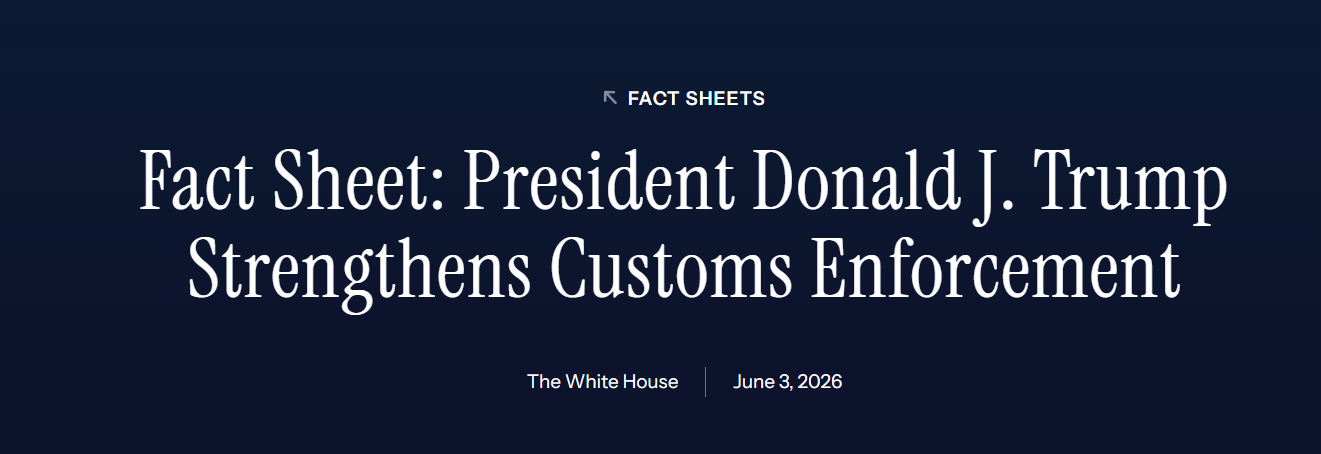
On June 3, 2026, the White House issued an executive order titled "Strengthening Customs Enforcement." If you import from China and you haven't heard about it yet, you're not alone — it landed with far less noise than the tariff headlines, but for many importers it matters more.
You can read the order yourself here: whitehouse.gov/presidential-actions/2026/06/strengthening-customs-enforcement. The accompanying fact sheet is here.
The order is about one thing at its core: who is accountable for what enters the United States, and whether that accountable party is actually reachable by US law.
CBP's own statement framed it plainly. According to Susan S. Thomas, Executive Assistant Commissioner of CBP's Office of Trade, the order helps CBP "better detect when bad trade actors try to break the rules" and represents "major advances in protecting our revenue and increasing supply chain transparency." CBP also stated directly that "customs brokers will also be held to higher standards and be required to conduct greater due diligence of their importers."
That last line is the one to pay attention to. Let me explain why.
The Thing Most Importers Don't Understand About the IOR
Every shipment entering the US has an Importer of Record — the IOR. The IOR is the party legally responsible for declaring the goods correctly, paying the duties owed, and complying with US customs law. Classification, valuation, country of origin, forced labor compliance — the IOR owns all of it.
Here's what many importers never fully grasped: the IOR doesn't have to be you.
Under the rules as they stood, a foreign company — including your Chinese supplier, or a freight forwarder — could act as the importer of record. They'd get a CBP-assigned number, post a bond, and file the entry. On paper, the liability for that shipment sat with them.
For some importers, this seemed convenient. Less paperwork. Less hassle. The supplier "handles customs." But convenience was never the real driver of these arrangements. The real driver was that when the liability sits with a foreign entity whose assets, operations, and people are all overseas, CBP has almost no practical way to enforce against it. The order itself says this directly: the United States faces "substantial barriers when seeking to enforce U.S. customs and trade laws against foreign actors like foreign IORs, particularly when assets, operations, and key individuals are located overseas."
This is the structure that companies like Temu leaned on. When questioned about US tariff obligations, Temu's position was that it "is not the importer of goods shipped to the US." The liability was someone else's problem — and that someone else was beyond easy reach.
That structure is what the June 3 order is built to close.
What the Order Changes
The order directs the Department of Homeland Security and CBP to rewrite the rules for importers of record. The headline changes:
Foreign IORs can no longer file informal entry. Informal entry — the lighter-touch process for shipments up to $2,500, with no bond and no broker required — is now reserved for US importers only. The order's reasoning: foreign importers handling high volumes of low-value goods face "lower penalty amounts and financial consequences for noncompliance."
Foreign IORs face heightened requirements for formal entry. They can no longer rely on a continuous bond (except where CBP specifically permits it and revenue is protected), and they must either be validated under CBP's CTPAT program or file through a CTPAT-validated, licensed US customs broker.
Every IOR must maintain "good standing" with CBP. And critically, good standing is based on the compliance history of the IOR and its affiliates. An IOR not in good standing cannot import — and cannot designate a broker to act as IOR on its behalf either.
A new minimum penalty floor. CBP's discretion to reduce penalties is now limited by a floor of not less than 50% of the assessed penalty. For repeat offenders, mitigation is eliminated entirely.
More disclosure. IORs will need to provide beneficial ownership disclosures, business affiliation disclosures, domestic asset disclosures, and anticipated import volumes. Foreign exporters will be required to hand CBP the same documentation they filed with their own country's customs administration — a direct cross-check against undervaluation and origin fraud.
One important note on timing: none of this takes effect tomorrow. The fact sheet is explicit that the reforms go through the standard rulemaking process, meaning "affected parties will have a meaningful opportunity to adjust operations." The directives carry 90- and 180-day deadlines for CBP to propose rules — actual enforcement will follow later. You have runway. The smart move is to use it.
The Good
For a legitimate US importer — a real company, with a real US entity, doing things properly — this order is largely good news.
It levels a field that has been tilted against you. If you have been competing against sellers who used offshore IOR structures and informal-entry loopholes to move goods with minimal compliance cost and minimal liability exposure, that cost advantage is being removed. The players who have been undercutting compliant importers on price — partly by not carrying the compliance burden you carry — lose the structure that made it possible.
It rewards discipline. Everything this order pushes toward — verified suppliers, documented origin, clean classification, real accountability — is what disciplined importers already do. If you've built your supply chain properly, you're ahead. The order moves the entire market closer to your standard.
It brings the US in line with global norms. As the fact sheet notes, most other countries already either prohibit foreign entities from acting as IOR or require foreign importers to partner with a verified domestic party. This isn't an exotic new burden. It's catching up to standard international practice.
The Bad
Now the honest part.
The liability is yours, and it's clearer than ever. If any part of your supply chain was relying on a foreign IOR to carry customs risk, that buffer is going away. You step into the IOR role fully — with real bonding, real disclosure, and real accountability. For most serious importers this is appropriate. But it's a change, and it has costs.
Good standing ties you to your affiliates. Your ability to import can now be affected by the compliance history of entities affiliated with you. If you have a messy classification past, a problematic affiliate, or a supplier relationship with enforcement history, that becomes a live risk to your ability to operate — not just a penalty after the fact.
Mistakes get more expensive. The 50% penalty floor and the elimination of mitigation for repeat offenders mean less room to negotiate down when something goes wrong. The cost of a classification error, a valuation problem, or an origin misstatement rises. Sloppiness that used to be survivable becomes costly.
Your broker is about to ask you harder questions. CBP has explicitly directed that brokers conduct greater due diligence on their importers. Expect your customs broker to start demanding documentation you may not currently have on hand — origin verification, supply chain detail, supplier identification. If you can't produce it, you have a problem that's now sitting in your lap, not your supplier's.
The Beautiful
Here's the part worth getting excited about.
The same change that creates risk for unprepared importers creates a durable advantage for prepared ones. And getting prepared is entirely achievable.
When compliance stops being optional, the importer who already has the documentation, the verified supplier relationships, and the clean origin trail isn't scrambling — they're operating normally while their competitors are paralyzed. The disruption that hurts the unprepared is exactly the disruption that separates you from them.
This is not a problem that requires panic. It requires preparation. And the preparation is the kind of work that makes your supply chain better regardless of what any executive order says — knowing your factory, knowing your origin, knowing your numbers. The order is simply making mandatory what was always good practice.
How to Get Ahead of It
Concrete steps, in rough priority order:
1. Confirm who your IOR actually is. This sounds basic. It isn't. Many importers — especially smaller brands — genuinely don't know whether they or a foreign party are listed as IOR on their entries. Pull your entry records. Find out. If a foreign supplier or forwarder is acting as your IOR, that arrangement needs to change, and you have time to do it deliberately rather than in a panic later.
2. Review your classification and valuation history. Look back at how your goods have been declared. Are the HTSUS codes accurate, or were they chosen to minimize duty? Is your declared value the actual transaction value? If something looks aggressive, address it now — the good-standing requirement and the penalty floor make a clean history more valuable than ever.
3. Map your supply chain — including tier two. Know not just your factory, but where your factory's critical inputs come from. The disclosure requirements and the broker due diligence demands will both push toward this. The importers who can produce a clean supply chain map will clear scrutiny that stalls everyone else.
4. Build your documentation file before you're asked for it. Origin verification, supplier identification, material certifications, manufacturing process documentation. The time to build this is now, contemporaneously, while you have access and runway — not after a broker request or a CBP inquiry lands.
5. Verify origin on the ground, not on paper. A supplier's certificate of origin is a piece of paper. Verified origin is someone confirming, at the factory, what is actually being made and where the inputs come from. As enforcement on origin and transshipment intensifies, the gap between a paper certificate and verified origin becomes the gap between clearing customs and getting detained.
A Note Going Forward
This order is new, and it will evolve. The rulemaking process means the specific requirements — bonding levels, the definition of "good standing," how "located in the United States" gets defined to prevent shell-company workarounds — will be filled in over the coming weeks and months. We'll be watching it closely, because the details will matter as much as the headline.
For now, the direction is clear: more accountability, less room for liability to hide offshore, and a real advantage for importers who know their supply chain cold. That direction isn't going to reverse. Preparing for it is simply good business.
What China Agent Does
China Agent provides on-the-ground factory relationship management and supply chain verification in China. We connect US importers directly to verified factories — no middlemen, no trading companies — and we build the documentation that real compliance now requires.
When your broker asks harder questions, you have answers. When you need to verify origin, identify sub-suppliers, or document your manufacturing process, the work is already done — because we're in the factory, not reviewing paperwork from a distance.
Our rule is simple: No inspection, no load. No customs readiness, no ETD.
The accountability is yours now. We make sure you can carry it.
Frequently Asked Questions
What is the "Strengthening Customs Enforcement" executive order? It is an executive order issued by the White House on June 3, 2026, directing the Department of Homeland Security and U.S. Customs and Border Protection to overhaul the rules governing importers of record, import disclosure, and customs enforcement. Key changes include barring foreign importers of record from filing informal entry, imposing heightened requirements on foreign IORs for formal entry, requiring all importers to maintain "good standing" with CBP, and establishing a minimum penalty floor of 50% of assessed penalties. The full text is published on the White House website.
What is an Importer of Record (IOR)? The Importer of Record is the party legally responsible for ensuring imported goods are correctly declared, that all duties are paid, and that the import complies with U.S. customs law — including classification, valuation, country of origin, and forced labor requirements. The IOR can be the owner, the purchaser, or in some cases a foreign party. Using a customs broker does not transfer this legal responsibility; the IOR remains accountable.
Can a Chinese supplier or freight forwarder be my importer of record? Until now, yes — a foreign company could act as IOR by obtaining a CBP-assigned number and posting a bond. This arrangement placed customs liability with the foreign entity, which CBP had limited practical ability to enforce against because its assets and operations were overseas. The June 3, 2026 executive order is designed to close this structure, barring foreign IORs from informal entry and imposing heightened bonding, validation, and disclosure requirements on them for formal entry.
When do the new customs enforcement rules take effect? Not immediately. The executive order directs CBP and DHS to develop rules through the standard rulemaking process, with directives carrying 90-day and 180-day deadlines for proposing those rules. Actual enforcement will follow. The accompanying White House fact sheet states that affected parties "will have a meaningful opportunity to adjust operations." Importers have a window to prepare before requirements take effect.
What is the "good standing" requirement for importers? The order requires all importers of record to maintain "good standing" with CBP, defined based on the compliance history of the IOR and its affiliates — including payment of customs liabilities and history of compliance with customs and trade laws. An importer not in good standing will not be permitted to import, and cannot designate a customs broker to act as IOR on its behalf. This ties an importer's ability to operate to its own and its affiliates' compliance track record.
What is CTPAT and why does the order require it for foreign importers? CTPAT (Customs Trade Partnership Against Terrorism) is CBP's voluntary supply chain security program. Members complete a supply chain security profile demonstrating they meet CBP's minimum security criteria, and are validated by CBP. Under the new order, foreign importers of record conducting formal entry must either be CTPAT-validated themselves or file through a CTPAT-validated, licensed U.S. customs broker — introducing a vetted, accountable U.S. touchpoint into the import process.
How can I prepare for the new customs enforcement requirements? Start by confirming who is listed as the importer of record on your entries — many importers do not know. Review your classification and valuation history for accuracy. Map your supply chain, including tier-two component suppliers. Build a documentation file covering origin, supplier identification, and manufacturing process before it is requested. And verify country of origin physically at the factory rather than relying on supplier certificates. These steps strengthen your compliance position regardless of how the specific rules are finalized.
Is this executive order good or bad for US importers? It depends on the importer. For compliant US companies with verified supply chains, it is largely positive — it removes the cost and liability advantage that non-compliant sellers gained through offshore IOR structures and informal-entry loopholes. For importers relying on foreign parties to carry customs liability, or with weak documentation and classification practices, it creates new exposure. The order rewards preparation and accountability, and the preparation required is achievable within the rulemaking timeline.