
China Customs Reform 2025 — What Importers Must Know Now
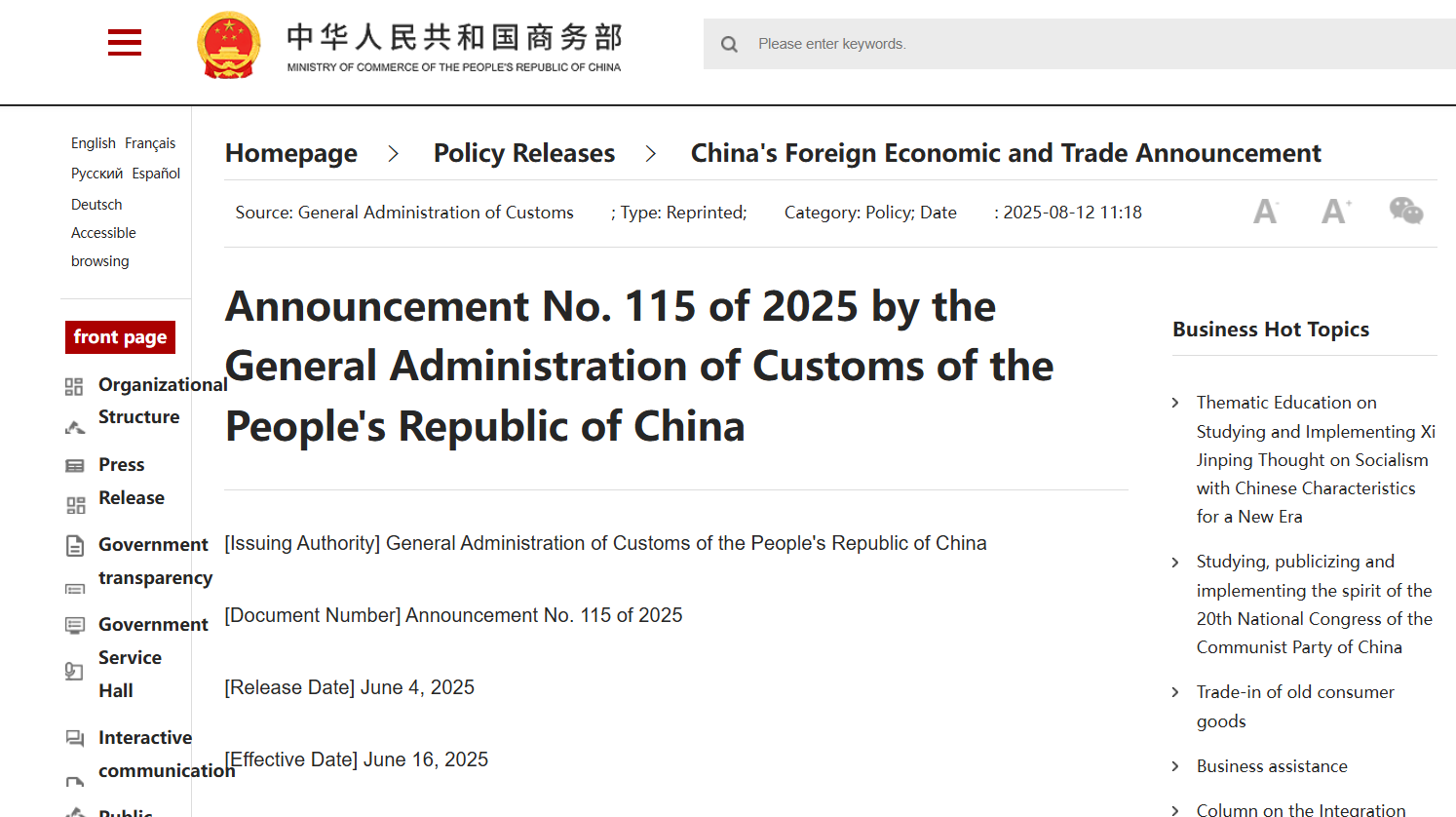
MUST READ : MOFCOM / GACC Official Notice (Announcement 2025 No.115)
China quietly changed how customs control works.
Not with headlines.
Not with speeches.
With systems.
In mid-2025, China Customs issued a nationwide reform that reshapes how declarations are filed, reviewed, and enforced. On the surface, it looks like a procedural update. In reality, it marks a deeper shift toward proof-based trade — where speed is allowed, but accuracy is tested later, and accountability is non-negotiable.
For importers and overseas buyers, this is not a technical footnote. It affects how invoices are issued, how data is matched, how suppliers behave, and where risk ultimately lands. Understanding this change now is the difference between smooth clearance and problems that surface when it’s already too late.
Official Notification — What China Customs Actually Issued
This article is based on an official customs notification issued by the General Administration of Customs of the People’s Republic of China (GACC) and republished by China’s Ministry of Commerce (MOFCOM).
This is not commentary.
This is not guidance.
This is enforceable customs policy.
The basics (clear and factual)
- Issuing authority: General Administration of Customs of China (GACC)
- Announcement number: 2025 No.115
- Release date: June 4, 2025
- Effective date: June 16, 2025
- National scope: All China customs offices
The notice formally rolls out China’s Two-Step Customs Declaration model nationwide.
This is a structural customs reform, not a pilot and not optional.
What the notice actually covers (important clarification)
This notice applies to import customs clearance into China.
It does not directly regulate export declarations.
That distinction matters, and we’ll be precise about it throughout this article.
However, import and export compliance in China are now built on the same core principle:
Data accuracy, traceability, and accountability.
What China is doing on the import side tells us exactly how enforcement logic works across the system.
What is the Two-Step Declaration — in plain business terms
Under the Two-Step Declaration model, customs clearance is split into two stages:
Step 1 — Simplified declaration
A limited set of key data is submitted so goods can be released faster.
This step focuses on:
- cargo identification
- basic transaction information
- risk screening
It is designed to reduce front-end friction.
Step 2 — Full declaration
The complete and detailed customs declaration must be submitted within the required timeframe after release.
This includes:
- full commodity details
- valuation data
- invoice alignment
- regulatory information
This is where accuracy is tested.
Speed comes first.
Verification comes after.
Why China Customs issued this notice
China Customs is trying to solve two problems at the same time:
- Improve clearance efficiency
Reduce congestion and delays at ports. - Strengthen post-release control
Shift enforcement from the border to data validation and audits.
In other words:
China is allowing goods to move faster —
while tightening accountability behind the scenes.
This is not deregulation.
It is re-engineering control.
What China Customs is really changing
Before this reform, clearance pressure was front-loaded.
Now it is back-loaded.
That means:
- mistakes may not block release immediately
- but they surface later as compliance issues
- and are harder to correct after the fact
Customs is moving from:
- “check everything before release”
to - “release first, verify everything later”
For compliant operators, this can be efficient.
For sloppy ones, it is dangerous.
Who is responsible under this model
Responsibility does not disappear under Two-Step Declaration.
It becomes clearer.
The party submitting the declaration — or appointing an agent to do so — remains responsible for:
- accuracy of declared data
- consistency between invoice, contract, and declaration
- timely completion of Step 2
- alignment with underlying commercial reality
Customs brokers do not absorb this risk.
Trading companies do not absorb this risk.
The legal responsibility stays with the declarant.
And commercial consequences travel downstream.
Why importers outside China should care
Many foreign buyers assume:
“This is China’s internal import process. It doesn’t affect me.”
That assumption is wrong.
This reform reinforces a broader enforcement model that China is applying across trade:
- tighter linkage between commercial documents and customs filings
- increased reliance on post-clearance audits
- less tolerance for inconsistencies
- more data sharing across platforms, banks, and authorities
Import-side reforms tell you how the system thinks.
And the system is moving toward proof-based trade.
Key takeaway
This notice confirms one thing clearly:
China Customs is no longer built around paperwork submission.
It is built around data verification after release.
Speed is easier.
Errors are more expensive.
What Changed — Before vs. After
China Customs did not change what must be declared.
It changed when, how, and where errors surface.
This matters because timing is now part of enforcement.
Below is the clean, operational comparison.
Customs Declaration Model: Before vs. After
|
Area |
Before (Traditional Model) |
After (Two-Step Declaration) |
|
Declaration timing |
Full declaration required before release |
Partial declaration first, full data after release |
|
Clearance focus |
Front-loaded document review |
Post-release data verification |
|
Error visibility |
Errors block shipment immediately |
Errors surface later through audits, corrections, penalties |
|
Speed |
Slower, more checks upfront |
Faster release, stricter follow-up |
|
Risk location |
At the port |
After the goods have moved |
|
Correction window |
Limited but immediate |
Time-bound, with higher consequence if missed |
This is the core shift:
speed up front, accountability later.
What “Two-Step” Really Means in Practice
The two steps are not equal in risk.
Step 1: Simplified Declaration (Release Phase)
At this stage, customs allows cargo to move with a reduced data set.
This typically includes:
- basic commodity identification
- transaction framework
- shipment details
- risk-screening inputs
This step is designed for efficiency, not forgiveness.
Customs is not saying:
“We don’t care about details.”
Customs is saying:
“We’ll check them later — thoroughly.”
Step 2: Full Declaration (Verification Phase)
This is where control lives.
The declarant must submit:
- complete commodity details
- accurate valuation
- invoice alignment
- supporting documentation
- regulatory data
This data must:
- match Step 1
- match commercial reality
- match upstream records
Any inconsistency becomes visible here.
And unlike the old model, the goods are already released.
That changes the consequences.
Why This Is a Real Change — Not a Cosmetic One
Under the old system, mistakes stopped shipments.
Under the new system, mistakes:
- trigger corrections
- invite scrutiny
- escalate into penalties
- expose patterns across shipments
Customs is moving enforcement from friction to forensics.
This is more efficient for the system — and more dangerous for careless operators.
Exporter and Agent Responsibility — No Shift, Just Clarity
A common misunderstanding is that Two-Step Declaration shifts responsibility.
It does not.
Responsibility remains with:
- the declaring party, or
- the party appointing the customs agent
Using a broker does not transfer liability.
Using a trading company does not dilute accountability.
China Customs has made this explicit by design.
Speed does not replace responsibility.
It sharpens it.
Data Accuracy Is No Longer a Timing Issue — It’s a Risk Issue
Before, inaccurate data caused delays.
Now, inaccurate data causes:
- post-clearance corrections
- compliance flags
- audit exposure
- cumulative risk scoring
Errors don’t disappear because goods moved.
They compound.
This is why documentation discipline matters before shipment — even if clearance looks smooth.
Practical Example (Simple, Realistic)
Before:
- Invoice mistake → shipment held → correction made → cargo released
After:
- Invoice mistake → shipment released
- Full declaration submitted → mismatch detected
- Correction demanded → pattern identified
- Future shipments flagged
The same mistake.
Very different outcome.
What China Customs Is Signaling With This Change
This reform tells importers one thing very clearly:
China Customs is no longer optimizing for paperwork review.
It is optimizing for data integrity across time.
The system assumes:
- trade volume will continue
- errors will occur
- enforcement should happen where it scales best
That place is after release, not at the gate.
Key Takeaway
Two-Step Declaration does not reduce compliance risk.
It redistributes it.
Speed is easier to obtain.
Accuracy is harder to escape.
Importers who treat clearance as a one-time event will struggle.
Importers who treat it as a data chain will adapt.
Enforcement Reality — This Is Already Happening
China Customs reform is not operating in isolation.
What changed in the declaration system is aligning with enforcement pressure that importers and suppliers are already feeling across platforms, banks, and daily operations.
This is not coincidence.
It is system alignment.
Platform Behavior Is Changing First
E-commerce and B2B platforms are now enforcement partners, whether they say so or not.
Across China-based platforms, we already see:
- stricter seller identity verification
- tighter linkage between seller accounts and legal entities
- transaction data retention requirements
- increased cooperation with tax and customs authorities
Invoices issued through platforms are no longer treated as “commercial documents only.”
They are treated as data inputs.
If invoice values, quantities, or descriptions drift from reality, that drift does not stay local to the platform.
It becomes searchable.
Banks Are No Longer Passive Pipes
Payment used to be a separate conversation.
It no longer is.
Chinese banks are now actively linking:
- inbound and outbound wires
- invoice values
- declared trade purpose
- counterparty identity
This means:
- mismatched invoices trigger questions
- split payments attract attention
- private account usage increases scrutiny
- repeated inconsistencies raise flags
Banks are not enforcing customs law.
They are enforcing data consistency.
And that consistency feeds other systems.
Private and Company Accounts Are No Longer Interchangeable
For years, many suppliers blurred the line:
- part company account
- part private account
- part “temporary solution”
That flexibility is closing.
When payments and invoices don’t align with:
- declared exporter
- declared transaction
- declared value
The problem is no longer administrative.
It becomes compliance risk.
This matters to importers because payment behavior is now evidence, not convenience.
Supplier Behavior Is Shifting — Quietly
Suppliers are adapting faster than buyers.
We see factories:
- asking more questions about invoice structure
- resisting under-invoicing requests
- pushing back on payment workarounds
- asking buyers to “keep documents clean”
This is not suppliers becoming difficult.
It is suppliers reacting to pressure upstream.
Factories understand something many buyers underestimate:
The risk no longer stops at shipment.
Trading Companies Are Not a Shield Anymore
Another outdated assumption:
“The trading company will handle compliance.”
That assumption no longer holds.
Trading companies are now subject to:
- the same data matching
- the same payment scrutiny
- the same platform reporting
If a trading company’s invoices, payments, and declarations do not align with reality, it becomes a liability — not a buffer.
Importers who rely on trading companies as a firewall are often surprised when issues surface anyway.
Why This Feels Sudden to Importers
From the importer’s perspective, it looks like:
- rules changed overnight
- banks suddenly care
- platforms suddenly enforce
- suppliers suddenly hesitate
In reality, none of this is sudden.
China Customs changed the center of gravity:
From:
- document submission
To: - data verification over time
Once that shift happens, every connected system starts to behave differently.
This Is Enforcement Without Noise
There are no public crackdowns.
No announcements aimed at foreign buyers.
That’s intentional.
Modern enforcement works best when:
- trade continues
- data accumulates
- patterns emerge
Problems surface later, when they are harder to unwind.
This is why many importers only realize there is an issue when:
- shipments are delayed unexpectedly
- future filings are questioned
- banks ask for explanations
- audits begin
By then, the cost of correction is higher.
Key Takeaway
China Customs reform is not theoretical.
It is already shaping:
- how invoices are issued
- how payments are reviewed
- how suppliers respond
- how platforms behave
Importers who treat customs compliance as a filing exercise will feel surprised.
Importers who treat it as a data system will stay ahead.
Why This Matters to Importers — Not Just Suppliers
A common assumption still floats around:
“This is the supplier’s problem.
They handle customs. They file the paperwork.”
That assumption no longer holds.
Under China’s current enforcement logic, the commercial risk travels downstream — and lands with the buyer.
Not because buyers broke the rules.
Because buyers fund the transaction.
Customs Issues Don’t Stop at the Border
When something goes wrong under the Two-Step Declaration model, the sequence usually looks like this:
- shipment clears quickly
- goods move
- full data is reviewed later
- discrepancies surface
- questions follow
At that point, the problem is no longer operational.
It becomes financial.
And that’s where buyers feel it.
How Importers Actually Get Hit
- Shipment Delays After “Successful” Clearance
Because enforcement is post-release, delays often appear later:
- future shipments held
- additional documentation demanded
- manual reviews triggered
- priority reduced
From the buyer’s side, it looks random.
It isn’t.
It’s cumulative risk catching up.
- Financial Exposure Through Corrections and Penalties
When invoices, values, or declarations don’t align:
- suppliers may be fined
- export activity may be restricted
- banks may freeze or delay payments
Suppliers rarely absorb these costs quietly.
They get pushed into:
- price increases
- retroactive charges
- payment delays
- order cancellations
The buyer ends up paying — indirectly or directly.
- Supplier Instability at the Worst Time
Compliance pressure changes supplier behavior.
Factories under scrutiny often:
- pause exports temporarily
- become risk-averse
- stop taking certain orders
- prioritize “clean” buyers only
Buyers discover this when:
- POs are delayed
- production windows shift
- capacity suddenly disappears
The issue isn’t quality.
It’s risk avoidance.
- Audit Exposure Moves Offshore
Even when the issue starts in China, it rarely ends there.
Data inconsistencies trigger:
- document requests
- explanation demands
- pattern reviews
Once trade data is flagged on one side, it becomes searchable on the other.
Importers may face:
- audit questions
- valuation challenges
- origin scrutiny
- delayed clearance abroad
At that point, the supplier’s mistake becomes the buyer’s problem to explain.
Why “It’s the Supplier’s Fault” Doesn’t Protect Buyers
Regulators don’t follow blame.
They follow data.
From their perspective:
- the buyer ordered
- the buyer paid
- the buyer benefited
That makes the buyer a natural point of accountability.
This is not about assigning guilt.
It’s about who carries exposure when systems detect inconsistencies.
The Quiet Shift Buyers Miss
Under older models:
- customs errors caused visible friction
- problems were fixed at the port
Under the new model:
- problems surface later
- corrections are harder
- exposure is broader
That’s why many buyers feel blindsided.
Nothing looked wrong — until it was.
What This Means in Practice
Importers can no longer treat customs compliance as:
- a supplier task
- a broker function
- a document exchange
It is now part of commercial risk management.
If the data chain breaks anywhere between:
- PO
- invoice
- payment
- declaration
The buyer absorbs the consequences — even if the supplier made the mistake.
Key Takeaway
China Customs reform makes one thing clear:
Compliance failures do not stay local.
They travel with the transaction.
Importers who rely on trust or habit will feel exposed.
Importers who build verification into their process will not.
Dumping, Pricing, and Cost Transparency — Why “Cheap China” Is Breaking
For years, many buyers benefited from prices that didn’t fully make sense.
Not because factories were miracle machines.
But because compliance was loose.
China Customs reform is closing that gap.
And when that happens, pricing behavior changes.
How Loose Compliance Created Artificially Low Prices
Below-cost pricing did not come from efficiency alone.
It came from combinations of:
- under-declared values
- mismatched invoices
- split payments
- private account settlements
- incomplete declarations
- weak post-clearance review
When compliance enforcement is light, these practices stay hidden.
They reduce:
- tax burden
- financial friction
- documentation pressure
That reduction shows up as “cheap prices.”
Not cheap production.
Cheap compliance.
Why Enforcement Removes the Dumping Advantage
Under the Two-Step Declaration model and aligned enforcement:
- invoice values must match reality
- payments must match invoices
- declarations must reconcile across time
- discrepancies accumulate
This removes the ability to quietly smooth margins through paperwork.
Factories and traders can no longer:
- adjust numbers after shipment
- spread risk across accounts
- rely on one-off fixes
When compliance tightens, prices normalize.
Not because China became expensive.
Because shortcuts stopped working.
Why Buyers Are Misreading Price Increases
Many buyers interpret rising quotes as:
“China is losing competitiveness.”
That’s not what’s happening.
What’s happening is:
- compliance cost is becoming visible
- risk is being priced in
- margin games are harder to hide
The factory that quoted unrealistically low before is now forced to:
- quote honestly
- reduce volume
- exit certain orders
Meanwhile, compliant factories see less volatility.
That’s the signal buyers should read.
The Dangerous Assumption Still in the Market
A common belief persists:
“Someone will always quote cheaper.”
In 2025 and beyond, the question is no longer:
- who is cheaper
It is:
- who can prove why
Prices without proof attract scrutiny.
Proofless savings disappear under enforcement.
Why “Cheap China” Is Now a Risk Signal
Extremely low pricing now correlates with:
- documentation gaps
- payment workarounds
- unstable suppliers
- higher audit exposure
Cheap does not mean illegal.
But it does mean fragile.
When enforcement pressure increases, fragile models fail first.
What Cost Transparency Really Means Now
Cost transparency doesn’t mean revealing factory margins.
It means:
- invoice accuracy
- payment alignment
- traceable value flow
- explainable numbers
If a price cannot be explained cleanly on paper, it will eventually be questioned.
This is the environment importers are entering.
The Buyer Shift That’s Already Happening
Experienced buyers are adjusting quietly:
- fewer suppliers
- longer relationships
- clearer contracts
- cleaner documentation
- less price chasing
They are not paying more for nothing.
They are paying for predictability.
Key Takeaway
Loose compliance enabled dumping-level pricing.
Enforcement removes that advantage.
What buyers are seeing now is not China becoming expensive.
It’s China becoming auditable.
Common Buyer Misunderstandings — Why Old Assumptions Fail in 2025
Most compliance problems don’t come from bad intent.
They come from outdated assumptions.
China Customs reform is exposing those assumptions — quietly and systematically.
Below are the most common ones we see, and why they no longer hold.
“This won’t be enforced.”
This is the most dangerous assumption.
Enforcement today is not loud.
It is cumulative.
China Customs is no longer looking for single violations.
It is looking for patterns over time.
A small mismatch today does not trigger a crackdown.
It builds a profile.
By the time enforcement becomes visible, the damage is already done.
“The trading company will handle it.”
Trading companies used to act as buffers.
That role is shrinking.
Today:
- trading companies file data
- banks review their payments
- platforms log their transactions
If the trading company’s data does not match reality, the risk does not disappear.
It simply moves.
Buyers relying on trading companies for compliance are often surprised when issues surface anyway.
“Private payments are separate from customs.”
They aren’t.
Banks now link:
- payment purpose
- invoice details
- counterparty identity
Private account payments do not avoid scrutiny.
They increase it.
When payments don’t align with declarations, questions follow.
“Invoices are optional.”
They never were.
But now, invoices are no longer just commercial documents.
They are enforcement tools.
Invoices are used to:
- validate declarations
- cross-check payments
- support audits
An invoice that doesn’t reflect reality is not a shortcut.
It’s a liability.
“This only affects large exporters.”
Smaller exporters are actually more exposed.
Why?
- fewer compliance resources
- less tolerance for mistakes
- higher dependency on workarounds
Large exporters adapt faster.
Small and mid-size operators feel pressure first — and pass it downstream.
“If something goes wrong, we’ll fix it later.”
This mindset worked under front-loaded clearance.
It fails under post-release enforcement.
Once goods are released:
- corrections are harder
- exposure is wider
- explanations are scrutinized
Fixing later is no longer cheaper.
It’s more expensive.
“Our relationship will protect us.”
Relationships still matter.
But they don’t override systems.
Customs does not see relationships.
Banks do not evaluate trust.
Platforms do not care who you know.
Systems evaluate data.
And systems don’t negotiate.
The Pattern Behind These Assumptions
All of these beliefs share one flaw:
They treat compliance as situational.
China Customs reform treats compliance as structural.
That’s the mismatch buyers are experiencing.
Key Takeaway
What worked before didn’t stop working because someone decided to enforce harder.
It stopped working because the system changed.
Buyers who update their assumptions will adapt smoothly.
Buyers who don’t will feel surprised — repeatedly.
What Importers Should Do Now — A Practical Checklist
China Customs reform doesn’t require panic.
It requires structure.
The goal is simple:
Make sure your trade data can explain itself — before anyone asks.
Below is a clear, operational checklist importers should act on this quarter, not someday.
Step 1: Verify Supplier Export Legality (Not Just the Name)
Do not assume your supplier is legally allowed to export what they are selling you.
Confirm:
- Business license is valid and active
- Export scope covers your product category
- Company name on invoice matches license exactly
- Exporter is not borrowing another entity’s license
If a trading company is involved:
- verify who actually files the declaration
- confirm who issues the invoice
- confirm who receives the payment
Mismatch here is a root cause of most problems.
Step 2: Validate the Invoice Flow End-to-End
Invoices are no longer “commercial paperwork.”
They are enforcement anchors.
Check:
- Invoice description matches actual product
- Quantity and unit price match PO and packing list
- Invoice value matches payment amount
- Currency and payment terms are consistent
- No unexplained invoice revisions after shipment
If your supplier asks to:
- split invoices
- delay invoicing
- issue “temporary” invoices
Stop and reassess.
Those shortcuts no longer age well.
Step 3: Align Payment Structure With Declared Reality
Payment behavior now creates evidence.
Confirm:
- Payments go to the same legal entity that invoices
- Payment purpose matches invoice description
- No mixing of company and private accounts
- No “balance later” arrangements
What feels convenient today often becomes a question later.
Banks are no longer passive.
Step 4: Review Customs Documentation Before Shipment
Do not wait for customs to find inconsistencies.
Before shipment, review:
- HS code selection
- declared value logic
- origin statements
- product descriptions
- consistency across documents
You don’t need to memorize customs law.
You need to make sure your documents tell one story, not five versions.
Step 5: Treat Small Orders With the Same Discipline as Large Ones
Small POs are not low risk.
In many cases, they are higher risk.
Apply the same checks to:
- test orders
- trial shipments
- first-time suppliers
Risk does not scale linearly with order size.
Step 6: Build a Simple Risk Monitoring Routine
You don’t need a compliance department.
You need visibility.
At minimum:
- track invoice changes
- track payment deviations
- track declaration corrections
- flag repeated “exceptions”
Patterns matter more than single events.
Step 7: Don’t Outsource Responsibility — Outsource Verification
Brokers, agents, and trading companies can file.
They cannot absorb your risk.
Use third parties to:
- verify suppliers
- review documents
- inspect production
- confirm reality matches paper
But keep responsibility where it belongs — with the buyer.
What This Checklist Really Does
This is not about perfection.
It’s about defensibility.
If customs, banks, or auditors ask:
“Explain this transaction.”
You should be able to answer — calmly, consistently, and with documents.
That’s the new standard.
Key Takeaway
China Customs reform rewards buyers who act early.
Not with praise.
With silence.
Silence is good.
The buyers who struggle are the ones who wait for a problem before fixing the process.
Realistic Case Scenarios — How Things Actually Break
China Customs reform doesn’t create new mistakes.
It exposes old ones faster — and later in the process.
Below are common scenarios we see, why they happen, and how they could have been prevented.
Case 1: Invoice Mismatch That Didn’t Matter — Until It Did
What happened
A supplier issued an invoice with a slightly adjusted unit price to “balance costs.”
The shipment cleared under Step 1 with no issue.
Weeks later, Step 2 data review flagged the discrepancy.
What went wrong
- Invoice value didn’t match PO and payment
- Adjustment was undocumented
- Correction request came after release
Why it escalated
Under post-release verification, the system compared:
- invoice
- payment
- declaration
The mismatch created a pattern, not a one-off error.
How it could have been prevented
- Lock invoice values before shipment
- Prohibit post-shipment “balancing”
- Require written justification for any price change
Case 2: Export Scope Failure Hidden by a Trading Company
What happened
A trading company issued the invoice.
The actual factory lacked export scope for the product category.
Clearance succeeded initially.
Months later, export activity was suspended pending review.
What went wrong
- Buyer assumed the trading company “covered” compliance
- Export scope mismatch wasn’t verified
- Declaration and production reality didn’t align
Why it escalated
China Customs tracks who produces and who declares — not just who invoices.
The structure looked compliant.
The reality wasn’t.
How it could have been prevented
- Verify factory export scope, not just trader license
- Confirm who files the declaration
- Confirm who bears legal responsibility
Case 3: Payment Flagged by Bank — Not Customs
What happened
Buyer split payments:
- part to company account
- part to a private account
Shipment cleared.
Bank flagged the transaction later.
What went wrong
- Payment didn’t match invoice
- Private account usage raised AML questions
- Purpose of funds unclear
Why it escalated
Banks now cross-check:
- payment purpose
- invoice details
- counterparty identity
The issue surfaced outside customs first.
How it could have been prevented
- Single payment to invoicing entity
- Clear payment purpose
- No private account settlements
Case 4: Two-Step Declaration Deadline Missed
What happened
Goods released under Step 1.
Full declaration submitted late due to internal delay.
What went wrong
- Compliance treated as administrative follow-up
- No deadline tracking
- No ownership of Step 2 responsibility
Why it escalated
Late completion under Two-Step Declaration is not neutral.
It signals:
- weak internal control
- low data discipline
That attracts scrutiny.
How it could have been prevented
- Assign ownership for Step 2 completion
- Track deadlines like financial obligations
- Do not treat post-release steps as optional
Case 5: Subcontracting Discovered After the Fact
What happened
Factory accepted order during a slow period.
Quietly subcontracted part of production to meet timing.
Documents remained unchanged.
What went wrong
- Production reality didn’t match declared origin
- Buyer had no on-ground visibility
- Supplier didn’t disclose change
Why it escalated
Customs and audit systems don’t care about intent.
They care about:
- consistency
- traceability
- transformation reality
How it could have been prevented
- On-ground inspection
- Production verification
- Contract clauses prohibiting subcontracting
The Pattern Across All Cases
None of these failures were dramatic.
No fraud.
No intent to deceive.
No immediate red flags.
They all shared one thing:
Data said one thing. Reality said another.
And under the new system, data always wins.
Why These Cases Matter
These are not edge cases.
They happen because:
- buyers rely on habit
- suppliers rely on flexibility
- compliance is treated as paperwork
China Customs reform turns these habits into liabilities.
Key Takeaway
Most problems don’t start at customs.
They start earlier — in:
- assumptions
- shortcuts
- undocumented changes
Under post-release enforcement, those choices don’t disappear.
They accumulate.
Which leads to the broader context.
Why this is not just a China issue — but part of a global shift.
Global Context — China Is Not the Exception
What China is doing with customs reform is not unusual.
It is early.
Across major trading jurisdictions, the direction is the same:
- less reliance on manual checks
- more reliance on data
- more post-clearance enforcement
- more cross-agency information sharing
China is not inventing a new model.
It is aligning with how modern customs systems operate globally.
Enforcement Is Shifting Everywhere — Quietly
Customs authorities worldwide are moving away from:
- paper-based review
- one-time clearance events
- reactive enforcement
And toward:
- continuous data monitoring
- risk profiling
- audit-driven control
- system-level consistency checks
China’s Two-Step Declaration fits cleanly into this pattern.
Release goods quickly.
Verify accuracy later.
Escalate when patterns appear.
Why Buyers Should Not Treat This as “China-Specific”
Many importers still think in geographic silos:
“China rules are strict. Others are easier.”
That gap is closing.
Authorities now cooperate more than buyers realize.
Trade data is:
- digitized
- standardized
- cross-referenced
- retained
When inconsistencies appear in one jurisdiction, they rarely stay isolated.
The issue may start in China.
But it often surfaces elsewhere.
The Real Shift Is Philosophical
Old model:
- customs checks shipments
New model:
- customs checks systems
That distinction matters.
Systems don’t forget.
They don’t negotiate.
They don’t rely on trust.
They look for:
- consistency
- traceability
- explainable behavior
China’s reform reflects this mindset clearly.
Why This Matters for 2026 and Beyond
As global trade slows and margins tighten, enforcement pressure does not ease.
It sharpens.
Authorities don’t need more inspections.
They need better data.
That is where investment is going.
China’s customs reform should be read as a signal:
Proof-based trade is no longer optional.
Not in China.
Not elsewhere.
Key Takeaway from Part 9
China is not tightening customs in isolation.
It is moving in the same direction as every serious trading system.
Importers who treat this as a temporary China issue will misread the trend.
Importers who build proof-based processes will adapt smoothly — everywhere.
Conclusion — Why Verification Now Matters More Than Ever
China Customs reform is not a temporary adjustment.
It is not a pilot.
It is not a policy experiment.
It is a structural shift in how trade is controlled.
Speed has been separated from verification.
Paperwork has been separated from proof.
And enforcement has been pushed downstream, where mistakes are harder to fix.
That changes where risk lives.
What This Reform Really Signals
China is not asking importers to do more paperwork.
China is asking importers to make sure their data reflects reality.
If your:
- supplier setup
- invoices
- payments
- declarations
do not align cleanly, the system will eventually surface it.
Not loudly.
Not immediately.
But reliably.
This is how modern enforcement works.
Why Reaction Is No Longer Enough
Many importers still operate in reaction mode:
- fix problems when shipments are delayed
- explain discrepancies after questions arise
- clean up documents once audits begin
That approach worked when enforcement was front-loaded.
It fails when enforcement is continuous.
Under the current model, the cost of reacting is higher than the cost of preparing.
Verification Beats Assumptions
The biggest risk importers face in 2025 is not non-compliance.
It is assuming compliance without verification.
Trusting:
- supplier assurances
- trading company buffers
- past experience
- “how it’s always been done”
without checking against current enforcement logic creates blind spots.
Those blind spots are what the new system exposes.
Where China Agent Fits
China Agent exists for this exact environment.
We do not wait for problems to appear.
We verify before money moves.
That means:
- checking supplier licenses and export scope
- validating invoice and payment structures
- reviewing customs documentation before shipment
- confirming production reality matches paperwork
- identifying risk before it becomes delay, penalty, or audit
This is not about control for control’s sake.
It is about keeping trade boring.
Boring trade clears smoothly.
Boring trade avoids surprises.
Boring trade protects margins.
Final Thoughts
2025 marks a clear dividing line.
Importers who continue to rely on habit will feel friction.
Importers who build proof into their process will not.
China Customs reform makes one thing clear:
Promises move goods.
Proof protects buyers.