
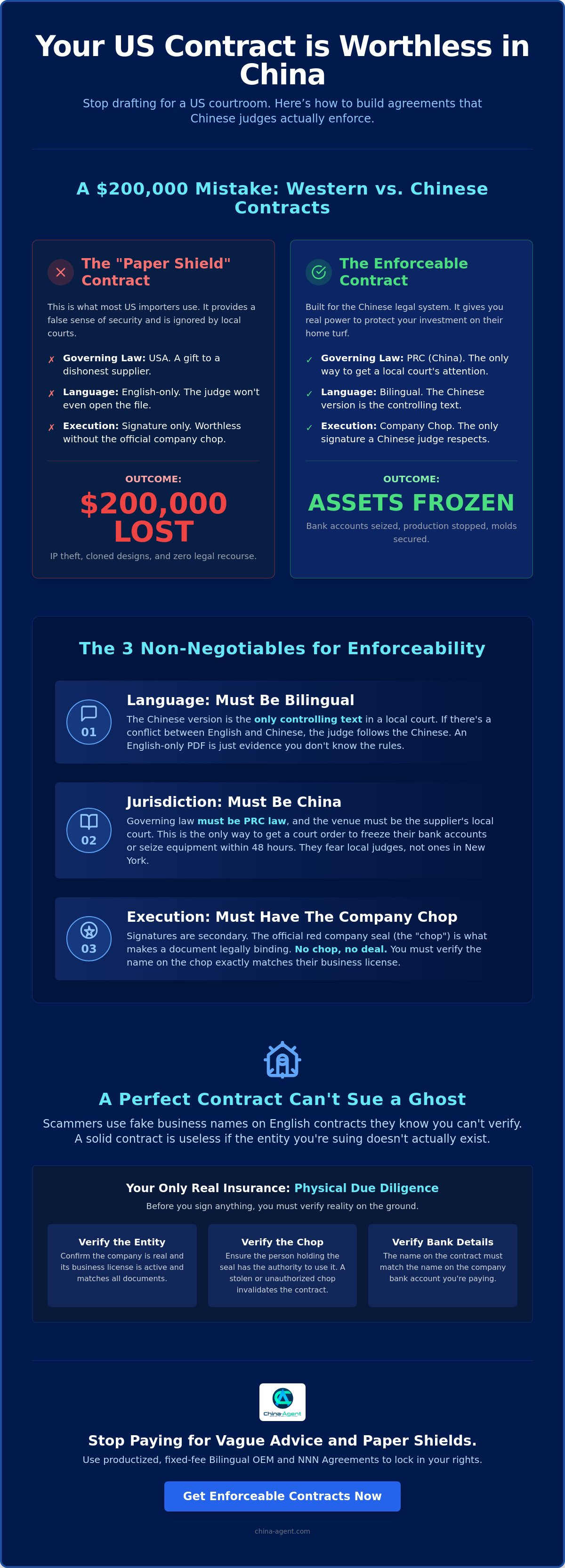
A California importer recently watched $200,000 vanish because their "bulletproof" contract was governed by US law. When the factory cloned their designs, the local judge in Ningbo wouldn't even open the file. The document wasn't bilingual; it lacked a physical company chop. To the court, it didn't exist. If you want chinese court enforceable contracts, you must stop drafting for a US courtroom and start drafting for a Chinese one.
Key Takeaways
- English-only contracts are useless in a local dispute. You'll see why the Chinese translation is the only version a judge truly cares about.
- To get chinese court enforceable contracts, you must name China as the venue. It’s the only way to freeze bank accounts and seize molds before they disappear.
- Suppliers don't care about US lawsuits they can ignore. They fear local courts that have the power to stop their production lines overnight.
- A contract is just paper if the factory is a shell. Learn why physical due diligence like a Supplier Reality Check™ is your only real insurance policy.
- Stop paying for vague legal advice or factory commissions. Use productized Bilingual OEM and NNN Agreements to lock in your rights with flat-rate transparency.
Why Your Western Contract is a Paper Shield in China
A Western contract in China is often just expensive confetti. You spend thousands on a US lawyer. They give you fifty pages of "whereas" and "heretofore." It looks professional in a Manhattan boardroom. In a Dongguan factory, it’s a joke. Chinese courts rarely recognize US court judgments. Even with the 2024 Civil Procedure Law amendments, the path to enforcement is narrow and steep. If you sue in New York and win, your supplier just keeps shipping. They know you can't touch their assets. They don't fear a judge they'll never meet in a country they'll never visit.
Choosing "Governing Law: New York" is a gift to a dishonest supplier. It’s an invitation to stall. To even start a case, you must navigate international service-of-process rules. This can take years. Your lawyers will bill you for every month of silence. By the time a Chinese judge sees the paperwork, the factory has moved, the molds are gone, and the bank accounts are empty. This is the definition of a "Paper Shield." It provides a false sense of security while leaving you completely exposed. To achieve chinese court enforceable contracts, you must play on the local field. You need a document that works in a Chinese courtroom on day one.
The historical roots of Chinese Contract Law emphasized stability and performance. Today’s Civil Code is even more focused on clear, localized evidence. If your contract isn't in Chinese, the judge won't read it. If it doesn't follow PRC law, the court won't enforce it. You aren't just writing for your protection; you're writing for a Chinese judge's approval.
The Myth of International Arbitration
SMEs often get pushed toward arbitration in Singapore or Hong Kong. It sounds safe. It’s actually a trap for the underfunded. Arbitration is slow and incredibly expensive. Even if you win an award, you still have to take that piece of paper to a local Chinese court for enforcement. This adds months of delay and thousands in extra fees. In 2026, local litigation is the pragmatic choice for chinese court enforceable contracts. It’s faster. It’s cheaper. Most importantly, it allows for immediate asset freezes that stop a supplier in their tracks.
The "Ghost Factory" Problem
A perfect contract cannot sue a company that doesn't exist. Scammers love English-only agreements because they can use fake business names that don't match their business license. Without a verified company chop, the document is worthless. The "chop" is the official red seal. It’s the only signature a Chinese judge respects. Before you sign anything, you need a Supplier Reality Check™. You must verify the entity is real and the person holding the seal actually has the authority to use it. If the name on the contract doesn't match the name on the bank account, you've already lost.
The 3 Non-Negotiables for Chinese Court Enforceability
If you want chinese court enforceable contracts, you have to stop thinking like a Western litigator. A Chinese judge doesn't care about your fifty-page English contract. If it isn't bilingual, it isn't evidence. The Chinese version will always be the "controlling" text in a local court. If there’s a discrepancy between the English and the Chinese, the judge follows the Chinese. If you didn't have a professional translate it, you've likely signed away your rights without knowing it. A judge in Ningbo won't hire a translator for your English PDF. They'll just toss the case.
Governing law is your second hurdle. It must be the People’s Republic of China (PRC). Trying to apply New York law in a Shenzhen court is a suicide mission. The judge won't know the law and won't bother to learn it. Even the U.S. Department of State notes in their reports on China Dispute Settlement that enforcing foreign judgments is nearly impossible. You need a local venue. Specifically, you want the court in the supplier’s city. It sounds risky to sue them on their home turf, but it’s the only way to get a court order to freeze their bank accounts or seize their equipment within 48 hours. Without local jurisdiction, you have no teeth.
Finally, there is the Company Chop. In the West, we value signatures. In China, signatures are secondary. The official red seal of the company is what makes the document legal. No chop, no deal. It’s that simple. If the factory owner refuses to chop the document with their official "round" seal, they're telling you they don't intend to follow it. You must verify that the name on the chop matches the name on their business license exactly. Any deviation makes the contract a scrap of paper.
Bilingual OEM and NNN Agreements
Forget the standard NDA. It’s too narrow for manufacturing. You need a Non-Disclosure, Non-Use, and Non-Circumvention (NNN) agreement. This prevents the factory from using your designs for other clients or selling directly to your customers. Our Bilingual OEM and NNN Agreements are updated for the 2026 Civil Code. They use precise terminology that local judges recognize instantly. We don't do "corporate-speak"; we do chinese court enforceable contracts that protect your molds and your market.
The Power of Liquidated Damages
Proving exactly how much money you lost to IP theft is a nightmare. You'd need years of audits and sales data that the factory will never provide. Instead, use liquidated damages. This is a pre-calculated penalty written into the contract text. If they steal your mold, they owe you a set amount. Period. You don't have to prove the loss; you only have to prove the breach. Keep the number high enough to hurt, but not so high that a judge dismisses it as an "excessive" penalty. This is the fastest way to force a settlement before you even step into a courtroom.
Jurisdiction and Venue: Why You Must Choose China
A factory owner in Foshan doesn't lose sleep over a summons from a California court. They throw it in the trash. They know you're thousands of miles away. They know the cost of pursuing them is higher than the deposit you lost. But if a local judge from their own district shows up, the tone changes instantly. Local judges have the power to shut down production lines. This is why chinese court enforceable contracts must designate a Chinese venue. As the Overseas Business Risk: China report confirms, contracts made outside the country are generally paper weights. You need to be inside the system to have any leverage.
Suing in the supplier’s home district is actually your biggest advantage. Many importers fear "home-court advantage," but the reality is simpler. That district is where their money is. If you sue in a neutral city like Shanghai for a factory located in Hebei, you’re adding layers of bureaucracy. In the factory’s home district, the court can execute an asset preservation order. This allows the court to freeze the factory’s bank accounts or seize their equipment in as little as 48 hours. When the boss can't pay his workers or buy raw materials, he stops hiding and starts negotiating.
The 2026 Commercial Mediation Regulations have added a new layer of speed to chinese court enforceable contracts. You no longer have to wait for a full trial to get results. These regulations allow for judicial confirmation of mediated settlements. If the factory agrees to a refund during mediation, that agreement becomes as enforceable as a final judgment. It’s faster, cheaper, and cuts through the noise of a standard legal battle.
Litigation vs. Arbitration in 2026
For most SMEs, litigation is the street-smart choice. Arbitration in Hong Kong or Singapore is a boardroom fantasy that costs tens of thousands before you even sit down. Litigation in a local Chinese court is a productized process. It’s better for "quality vs. payment" disputes where the facts are on the ground. Use arbitration only if you’re protecting high-level trade secrets that a local judge might not grasp. For everything else, go to court.
Local Court Mechanics
Navigating the bureaucracy requires more than just a lawyer. You need a Fixer Service to handle the physical reality of the case. Since 2026, digital court filings have streamlined the process for foreign plaintiffs, but you still need a verified Chinese business address for the defendant. If you’re suing a "ghost" address, the digital system will reject you. You must prove the factory exists in the physical world before the digital court will listen.
Beyond the Paper: Why Verification is the Real Enforcement
I once walked into a "factory" in Ningbo that looked perfect on paper. The business license was current. The website showed rows of CNC machines. The contract was a masterpiece of legal drafting. But when I stood at the coordinates provided, I found a shared office space with three desks and a water cooler. No machines. No inventory. Just a middleman with a laptop and a red stamp. If you sign chinese court enforceable contracts with a ghost, you’ve already lost. A judge can award you millions, but they can't seize assets that don't exist. You can't sue a shell company and expect a payout.
Your contract is only as strong as the factory’s balance sheet. If the supplier is a "trading company" with zero physical footprint, your legal protection is a fantasy. This is why we prioritize physical verification over digital promises. You need to know if the company owns the land, the building, or at least the equipment inside. Before you send a single dollar, you need a Supplier Reality Check™. We go to the site. We look at the machines. We verify that the name on the business license matches the name on the front gate. This isn't corporate due diligence; it's a street-level investigation to ensure there’s something for a court to freeze if things go south.
On-the-ground presence beats a New York legal team every time. A lawyer in a skyscraper can't tell you if a factory is subletting its space to a dozen other "companies." They can't see the red flags in the warehouse. We act as your eyes and ears, filtering out the scammers before they touch your IP. Our Due Diligence service identifies shell companies that have no intention of honoring a contract. We look for the assets that make a lawsuit worth pursuing.
Physical Factory Audits as Legal Security
We don't just check the paperwork. We match the serial numbers on the machinery to the company’s asset registry. A physical audit prevents contractual default by confirming the entity signing the deal actually owns the machinery and inventory needed to fulfill your order and pay out a court-ordered penalty. If they’re renting their equipment, they can disappear overnight. If they own it, they have a reason to stay and play by the rules.
The Role of the "Fixer" Service
A contract is a tool for negotiation, not just a trigger for a lawsuit. Most disputes in China are settled in a manager's office, not a courtroom. When we show up as a Fixer Service, we carry your bilingual agreement as leverage. We remind the factory boss that we know where his warehouse is and which local court has jurisdiction. This on-site pressure often resolves "quality issues" in hours. They realize that ignoring a foreign email is easy, but ignoring a professional on their factory floor is impossible.
Protect your investment before the first deposit. Run a Supplier Reality Check™ today to verify your factory’s physical assets.
Fixed-Fee Legal Protection: The China Agent Approach
The manufacturing industry is built on hidden kickbacks. Most agents take "introductions" and then pocket a percentage of your order behind your back. They aren't protecting you; they're compromised. We reject the commission model entirely. You pay us for reports and results, not for "friendships" with factory bosses. This independence is the only way to deliver chinese court enforceable contracts that actually work. If we took a cut from the supplier, we couldn't tell you the truth when their quality slips or their assets disappear.
Our approach is productized and transparent. You don't need a three-month legal discovery phase. You need Bilingual OEM and NNN Agreements that follow a proven, flat-rate structure. Over 17 years, we've seen every trick in the book. We know which clauses a judge in a Tier-2 city will uphold and which ones they'll ignore. We build your legal shield based on what we've seen on the factory floor, not what we read in a legal textbook. This is how we ensure you have chinese court enforceable contracts that stand up to local scrutiny.
Your Manufacturing Sentinel
Importers in high-stakes markets like NYC and LA hire us because they can't afford to be wrong. They need a sentinel. We provide the eyes and ears that a digital platform can't offer. Our Monthly Support isn't a vague retainer. It’s active monitoring. We verify that the factory you signed with in January is still the same entity in July. In a landscape where suppliers often sublet orders to smaller, unverified shops, this vigilance is your only real security. We work for you, not the factory.
Securing Your Supply Chain Today
If you're currently negotiating a deal, stop. Don't sign an English-only document. Don't send a deposit to a personal bank account. The transition from a vulnerable buyer to a protected partner starts with a single step: verification. You must confirm the physical reality of the supplier before you worry about the legal one. Once the assets are verified, you lock them down with a document that has local bite. Don't leave your IP to chance.
Secure your manufacturing rights with a Bilingual OEM Agreement and ensure your supplier knows exactly what happens if they cross the line. We get in, deliver the protection you need, and ensure you have the leverage required to win. Your business deserves more than a paper shield.
Stop Drafting for Boardrooms and Start Drafting for Reality
We don't take factory commissions. We don't hide behind hourly legal fees. Our process is productized and transparent. You get a fixed-fee solution that prioritizes your protection over a middleman's kickback. Take control of your supply chain before the next shipment leaves the dock. Get a Fixed-Fee Bilingual OEM Agreement for Your China Manufacturing and secure your interests today. You can manufacture with confidence when you have the right leverage in place.
Frequently Asked Questions
Is a US contract enforceable in a Chinese court?
No. Chinese courts rarely recognize or enforce US judgments. If your agreement is governed by New York law, a judge in Ningbo will likely ignore it. To have chinese court enforceable contracts, the document must be governed by PRC law and designate a Chinese venue. Without local jurisdiction, you're just holding a piece of paper with no power to freeze assets.
What is the difference between an NDA and a China NNN agreement?
An NDA only stops a supplier from talking about your design. A China NNN agreement stops them from using it (Non-Use) and selling it to your customers (Non-Circumvention). Most factories sign an NDA and then manufacture your product for their own profit. An NNN agreement includes liquidated damages that make this betrayal too expensive for them to risk.
Why do I need my contract to be in Chinese?
Chinese judges conduct proceedings in Chinese. They won't translate your English PDF. If the contract isn't bilingual with a controlling Chinese version, the court won't accept it as evidence. You need the judge to read your penalty clauses instantly. A professional translation ensures the terminology matches the 2026 Civil Code updates so there's no room for "misinterpretation" by the factory boss.
What is a "Company Chop" and why is it mandatory for enforcement?
The chop is the official red seal of the business. In China, a signature is just a scribble that's easy to disavow. The chop is the legal proof that the company is bound to the agreement. If the red seal doesn't match the name on the business license exactly, the contract is void. No chop means no deal; it's the first thing a judge looks for.
Can I sue a Chinese supplier if I only have their Alibaba Gold Status?
No. Gold Status is a paid marketing badge; it isn't a legal verification. I've walked into "Gold" factories that were actually empty apartments. You can't sue a marketing status. You need the actual business license name and a verified physical address. Before signing anything, you must verify that the entity has real assets a court can seize.
How long does it take to enforce a contract in China in 2026?
Litigation typically takes six to twelve months. However, the 2026 Commercial Mediation Regulations have streamlined the path to settlement. If you have chinese court enforceable contracts, you can often get an asset freeze order in 48 hours. That immediate pressure on their bank account usually forces the factory to settle the dispute before you ever reach a full trial.
Do I need to hire a Chinese lawyer to draft my manufacturing agreement?
You need a specialist who understands both the 2026 legal framework and the factory floor. We provide productized Bilingual OEM and NNN Agreements that are built for enforcement. A standard lawyer often drafts "boardroom" documents that fail when they hit the reality of a local district court. You need a document that a local judge will respect and uphold.
What happens if a Chinese factory steals my IP but I have no contract?
You're in a high-stakes fight with very few weapons. You'd have to rely on trade secret laws under the March 2026 Revised Foreign Trade Law. This is expensive and slow. The factory will simply claim they "independently developed" your design. Without a pre-signed bilingual agreement, proving ownership in a Chinese court is a steep, uphill battle that most SMEs lose.
Disclaimer
China Agent provides supplier verification and due diligence for businesses importing from China. We do not source, supply, manufacture, test, or transport any products, and we are not a middleman. Nothing here is legal, financial, customs, medical, or regulatory advice. This content is general and educational and reflects our experience on the ground in China. Laws, tariffs, and the legal status of any product vary by jurisdiction and change over time — you are responsible for complying with the rules that apply to you. For decisions with legal or financial consequences, consult a qualified professional.