
Your Supplier Just Got Named a "Chinese Military Company." Now What?
A Different Kind of Risk Just Showed Up
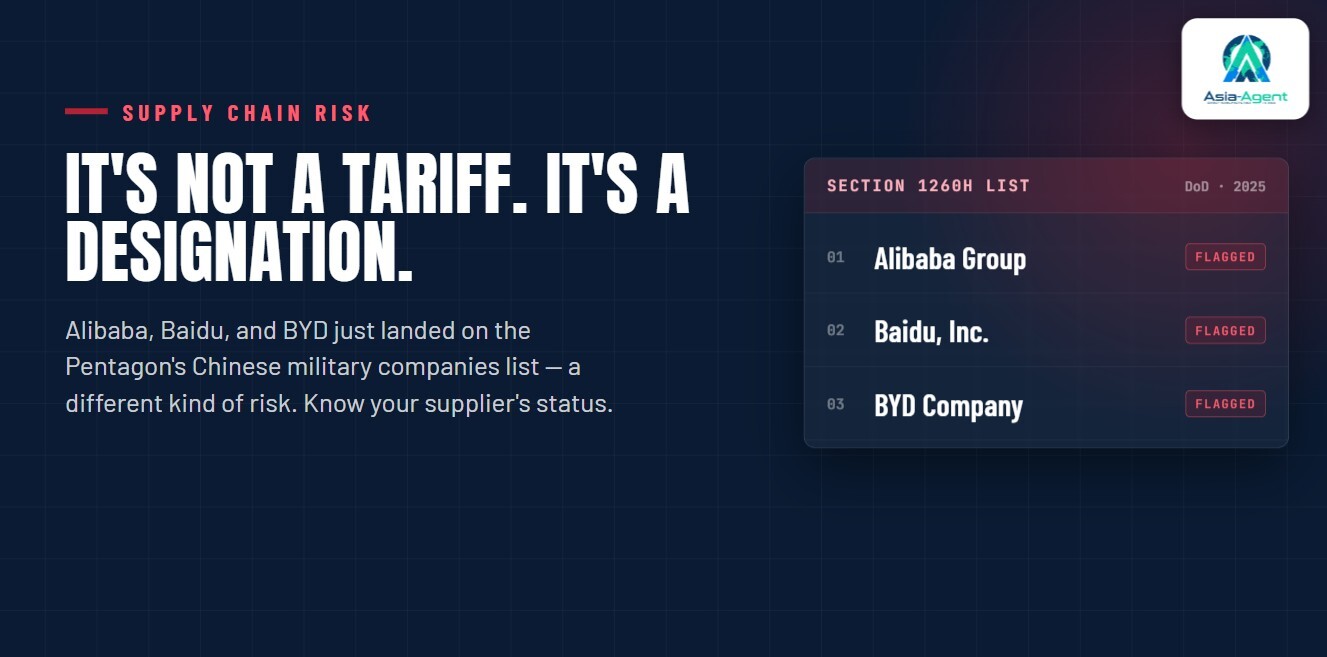
On June 9, 2026, the US added Alibaba, Baidu, and BYD to its list of Chinese military companies. Three of the largest, most familiar names in Chinese business — an e-commerce and cloud giant, a search and AI company, and the world's leading EV maker — flagged by the US government.
The designation indicates possible restrictions on US defense-related contracting and is meant, per reporting, to warn suppliers and government buyers rather than impose a complete business ban. Alibaba denied the labeling and said it would challenge the designation as discriminatory and an overstretch of national-security concepts.
Set aside the politics. For an importer, this event points to a category of supply chain risk that has nothing to do with tariffs and that most buyers never think about until it lands on them: designation risk. A company in your supply chain — or a platform you transact through — can be placed on a US government list, and when that happens, it becomes your problem in ways a tariff never does. This is worth understanding before it touches you, not after.
What Designation Risk Actually Is
A tariff is a cost. You calculate it, you price it in, you pay it. It's painful but predictable, and it applies to everyone importing the same thing.
A designation is something else entirely. It's a specific entity being placed on a specific government list for a specific reason — military ties, forced labor, national security, export control concerns. There are several such lists, maintained by different parts of the US government, and they carry different consequences. Some restrict government contracting. Some, like the forced-labor entity list, can bar goods from import entirely. Some affect financial dealings or investment. The common thread is that a designation attaches to a company, not a product — and if that company is in your supply chain, the designation can flow through to affect you.
This is a fundamentally different risk than tariffs because it's binary and specific rather than broad and gradual. A tariff raises your cost by a percentage. A designation can suddenly make a supplier relationship a liability — reputationally, contractually, or operationally — regardless of the tariff rate, regardless of how good the product is, regardless of how reliable the supplier has been. It's not a dial that moves. It's a status that flips.
Why This Matters Even When the Designation Isn't a Ban
The Alibaba case is instructive precisely because the designation is described as a warning, not a complete ban. Buyers might conclude that means it doesn't matter. That would be a mistake.
Even a designation that doesn't legally prohibit business with a company creates real consequences:
Reputational exposure. Being associated with a supplier the US government has flagged as a military company carries reputational risk, particularly for brands that sell to government, defense-adjacent, or values-conscious customers. The designation becomes a fact about your supply chain that others can point to.
Contractual and customer complications. Your own customers — especially larger ones, government buyers, or those with their own compliance requirements — may have policies that restrict dealing with designated entities or anyone in their supply chain. A supplier's designation can put you in breach of your customers' requirements even if it doesn't violate any law directly applicable to you.
The risk of escalation. A designation that's a "warning" today can become a harder restriction tomorrow. Lists get expanded, consequences get tightened, and a company flagged in one context can be added to lists with sharper teeth. A designation is also a signal — it tells you the US government has concerns about an entity, and those concerns have a way of growing rather than shrinking.
Financial and banking friction. Banks and financial institutions have their own compliance screening. A designated entity in your transaction chain can create friction in payments, financing, and banking relationships, even absent a formal prohibition.
So "it's just a warning" is the wrong way to read it. The right way is: a company in this category has become a flagged entity, and flagged entities carry consequences that can grow.
The Broader Lesson: Know Your Supplier's Status, Not Just Their Product
This connects to a theme that runs through how a serious importer should think about their supply chain. You need to know more about your suppliers than whether they make a good product at a good price.
Most buyers evaluate a supplier on the obvious dimensions: can they make it, at what quality, at what price, on what timeline. Those matter. But they're incomplete. A supplier can be excellent on every one of those dimensions and still carry a designation — or be at risk of one — that makes them a liability to your business. The product is fine. The entity is the problem.
Knowing your supplier's status means understanding who they actually are at the entity level: their ownership, their affiliations, their connections to entities or activities that draw government designations, and whether they or their parent or affiliates appear on — or are plausibly headed toward — any of the relevant lists. This is the same entity-level due diligence that matters for forced-labor exposure, for the importer-of-record rules, and now for designation risk. The questions overlap because they're all about knowing who you're actually dealing with, not just what they sell.
The Alibaba designation is a reminder that even the largest, most established, most familiar Chinese companies can land on a list. If it can happen to them, the assumption that your supplier is "too normal" to carry this risk is not a safe assumption.
How to Manage Designation Risk
Concrete steps.
Know who your suppliers actually are at the entity level. Beyond the product and the price, understand your supplier's ownership, corporate structure, and affiliations. Designation risk attaches to entities and can flow through ownership and affiliation, so knowing the real structure behind your supplier is the foundation.
Check your supply chain against the relevant lists. Several US government lists carry designation consequences — military company lists, the forced-labor entity list, export-control lists, and others. Knowing whether any entity in your supply chain, including parents and affiliates, appears on these lists is basic risk hygiene that most importers skip.
Understand your own customers' requirements. Your exposure to a supplier's designation often comes through your customers' compliance policies. Know what your customers require regarding designated entities, so you understand how a supplier's status could put you in breach even when it doesn't directly violate a law applicable to you.
Watch for escalation signals. A designation is a signal that the US government has concerns about an entity. Treat it as information about where risk may be growing, not just a present-day fact. A supplier flagged in one context may face sharper consequences later, so a current designation — even a mild one — is a reason for heightened attention to that relationship.
Build the knowledge before you need it. Like most supply chain risks, designation risk is far cheaper to manage before it materializes than after. Knowing your suppliers' entity-level status as part of your normal due diligence means you're not scrambling to understand your exposure after a designation has already landed and started creating problems.
A Note Going Forward
Designations and the lists behind them are an active, expanding tool of US policy, and the trend is toward more entities being flagged across more categories, not fewer. We're tracking how these designations develop, because for an importer, a supplier landing on a list can matter as much as any tariff — and it arrives with less warning. The Alibaba, Baidu, and BYD designations are a marker of a risk category that deserves a place in how importers evaluate their supply chains.
The lesson is straightforward: know your supplier's status, not just their product. A great product from a flagged entity is still a problem. The only way to manage that risk is to know who you're actually dealing with, at the entity level, before a designation makes it urgent.
What China Agent Does
China Agent provides on-the-ground factory relationship management and supplier verification in China. We help importers understand who their suppliers actually are at the entity level — ownership, structure, and affiliations — which is the foundation for understanding designation risk and the other entity-level exposures that a product-and-price evaluation misses.
We connect you directly to the factory, with no middleman, and we help you know not just whether your supplier makes a good product, but who they actually are — so a designation, a listing, or an affiliation doesn't become a surprise liability in your supply chain.
Our rule is simple: No inspection, no load. No customs readiness, no ETD.
Frequently Asked Questions
What does it mean when a company is added to the US Chinese military companies list? It means the US government has identified the company as having ties it associates with the Chinese military, which can indicate possible restrictions on US defense-related contracting. In the June 9, 2026 case involving Alibaba, Baidu, and BYD, the designation was reported as meant to warn suppliers and government buyers rather than impose a complete business ban. However, the designation attaches to the company and carries reputational, contractual, and potential escalation consequences beyond any formal prohibition.
What is "designation risk" and how is it different from tariffs? Designation risk is the risk that a company in your supply chain is placed on a US government list — for military ties, forced labor, national security, or export-control concerns. Unlike a tariff, which is a calculable cost applied broadly to products, a designation attaches to a specific entity and is binary: a status that flips rather than a dial that moves. It can make a supplier relationship a liability regardless of the product's quality or the tariff rate, and it can flow through to affect any importer in that supplier's chain.
If a designation is just a "warning" and not a ban, does it still matter? Yes. Even a designation that doesn't legally prohibit business creates real consequences: reputational exposure from being associated with a flagged supplier, contractual complications if your own customers have policies restricting designated entities, the risk that a warning-level designation escalates to a harder restriction later, and financial friction as banks apply their own compliance screening. Reading a designation as harmless because it isn't a full ban underestimates the consequences that can attach to a flagged entity.
How can my supplier's designation affect my business if it doesn't apply to me directly? Primarily through your customers and your business relationships. Larger customers, government buyers, and compliance-conscious companies often have policies restricting dealings with designated entities or anyone in their supply chain. A supplier's designation can therefore put you in breach of your customers' requirements even when no law directly applicable to you is violated. Reputational association and banking friction can also affect your business indirectly, independent of any direct legal prohibition.
Why should I know my supplier's entity-level status, not just their product? Because a supplier can be excellent on product, price, quality, and reliability and still carry a designation — or be at risk of one — that makes them a liability. The product being fine doesn't mean the entity is safe. Knowing your supplier's ownership, structure, and affiliations reveals whether they connect to entities or activities that draw government designations. This entity-level knowledge is the same due diligence that matters for forced-labor exposure and importer-of-record rules: knowing who you're actually dealing with, not just what they sell.
Can large, well-known Chinese companies really be designated? Yes. The June 9, 2026 designations involved Alibaba, Baidu, and BYD — three of the largest and most familiar names in Chinese business. This demonstrates that size, prominence, and familiarity do not protect a company from being placed on a US government list. The assumption that a supplier is "too normal" or "too established" to carry designation risk is not safe, since even the biggest Chinese companies have been flagged.
How do I manage designation risk in my supply chain? Know your suppliers at the entity level — their ownership, structure, and affiliations, since designation risk flows through ownership and affiliation. Check your supply chain, including parents and affiliates, against the relevant US government lists. Understand your own customers' compliance requirements regarding designated entities. Watch for escalation signals, treating a current designation as information about where risk may grow. And build this knowledge as part of normal due diligence before a designation materializes, since it is far cheaper to manage in advance than after it has already created problems.