
Chinese New Year Will Wreck Your Q1. Here's the Plan You Need by October.
The Most Predictable Disruption in Manufacturing — and the One Buyers Plan for Last
Every year, China's factories effectively shut down for two to four weeks around Chinese New Year. Every year, it's on the calendar months in advance. And every year, a wave of Western buyers gets caught short — late orders, missed Q1 launches, quality problems they didn't see coming.
This is the strangest thing about the CNY disruption: it is the single most predictable event in Chinese manufacturing, and it's the one buyers consistently fail to plan for. A tariff change is a surprise. A port closure is a surprise. Chinese New Year is not a surprise. It happens every year, on a known schedule, and it does the same things to production every time.
If you manufacture in China and you're not building your plan around it by October, you're already behind. Here's what actually happens, and what to do about it.
What CNY Actually Does to Production
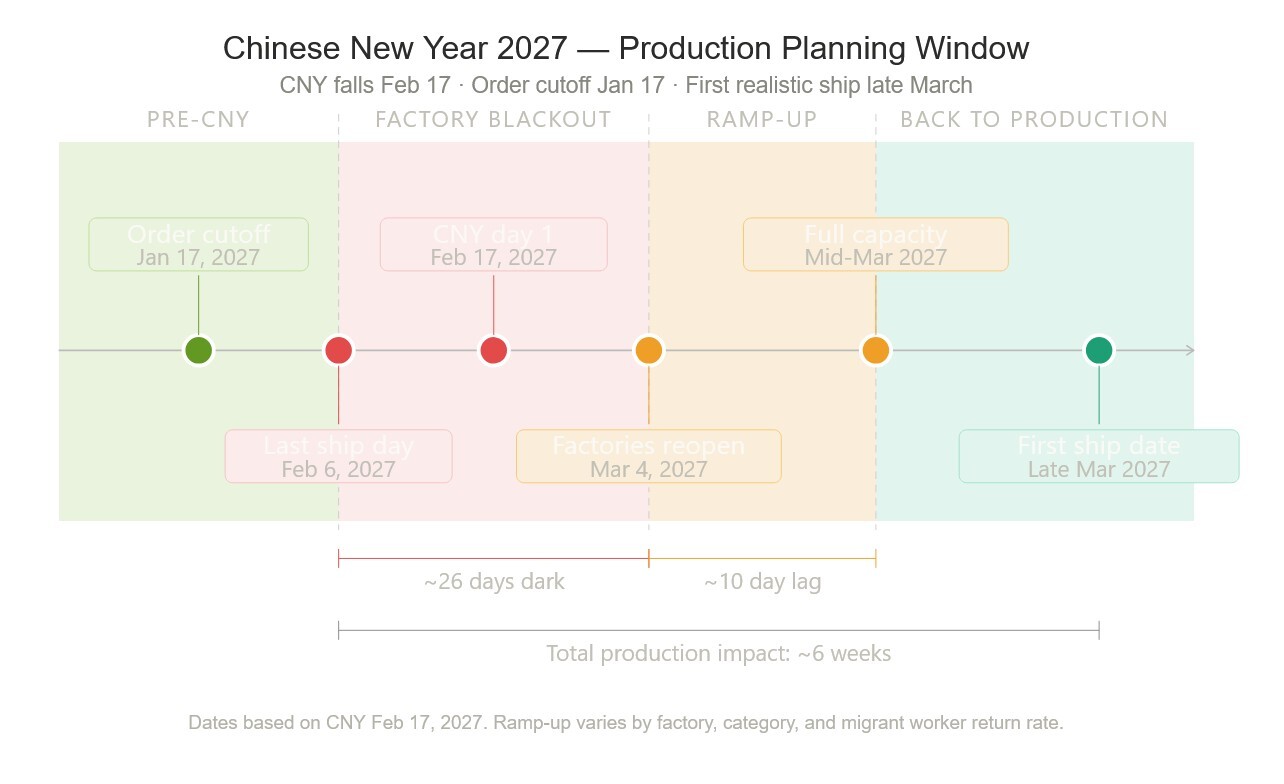
The shutdown itself is the obvious part. But the disruption isn't a clean two-week pause — it's a degradation curve that starts weeks before the holiday and extends weeks after. Understanding the shape of it is the whole point.
Before the break: quality drops as the deadline closes in. In the weeks leading up to CNY, factories are racing to clear orders before they shut down. Lines run faster. Workers are pushing to finish and get home for the most important holiday of the year. Attention slips. This is one of the highest-risk windows in the entire production calendar — goods made in the final pre-CNY push are statistically more likely to carry defects, because the entire factory is optimizing for speed over care. The order you rushed to get in before the holiday is the order most likely to have problems.
During the break: nothing moves, and the runway is longer than the holiday. The official holiday is about a week, but the practical shutdown runs two to four weeks for most factories. Migrant workers travel long distances home and don't all come back on the same day. Materials suppliers shut down too, so even a factory that reopens on schedule may not have the inputs to run. Your production isn't just paused for the holiday — it's paused until the entire supply chain around your factory comes back online.
After the break: the workforce isn't the same one that left. This is the part buyers understand least. Chinese New Year is the single biggest job-switching moment of the year for factory labor. Many workers don't return to the same factory — they take a better offer, stay closer to home, or leave manufacturing entirely. Factories often reopen with a meaningfully different, less experienced workforce. The skilled operator who made your flawless pre-holiday sample may simply be gone. Post-CNY production quality frequently dips while new workers come up to speed — exactly when you're trying to recover your delayed timeline.
The Three Mistakes That Wreck Q1
The CNY disruption turns into a Q1 disaster through the same three mistakes, every year.
Mistake 1: Ordering late and rushing into the pre-holiday window. A buyer places an order that lands in the final pre-CNY push, betting the factory can finish before the shutdown. The factory says yes — they want the business — and rushes it through during the lowest-quality, highest-pressure window of the year. The goods either don't finish in time, or they finish with defects. Both wreck Q1.
Mistake 2: Underestimating the shutdown length. Planning around the official one-week holiday instead of the real two-to-four-week practical shutdown. The math doesn't work, the goods arrive weeks later than planned, and a Q1 launch slips.
Mistake 3: Trusting post-CNY production without extra verification. Assuming the factory that performed well in November will perform identically in March, when in fact it may be running with a partly new workforce still climbing the learning curve. Quality dips that would have been caught with closer oversight sail through, and the defects show up in your warehouse.
The Plan You Need by October
Working backward from a typical late-January or February CNY, here's the timeline that keeps Q1 intact.
By October: lock your production schedule. Decide what has to be delivered before CNY and what can wait until after. Get your pre-CNY orders placed early enough that they run during normal production, not the final rushed window. The single most effective move is simply ordering early — giving the factory time to make your goods properly before the pre-holiday scramble begins.
By November-December: build in the buffer and front-load critical inventory. If you need stock for Q1, get it made and shipped before the shutdown, with enough buffer to cover the full two-to-four-week practical closure plus the slower ramp afterward. Don't plan to the official holiday dates — plan to the real ones. Carry enough inventory to bridge the entire disruption window, not just the calendar holiday.
Before the break: increase verification on pre-CNY production. The pre-holiday window is high-risk for quality. This is exactly when on-the-ground inspection earns its keep — catching the defects that the pre-holiday rush is more likely to produce, before the goods ship and before the factory closes and becomes unreachable for weeks.
After the break: verify before you trust. When the factory reopens, don't assume continuity. Confirm the workforce, confirm the first post-holiday production runs meet spec, and watch quality closely until the factory is genuinely back up to its normal standard. The post-CNY ramp is a verification priority, not a formality.
Why This Is a Relationship Problem, Not a Calendar Problem
You can know all of this and still get burned, because the dates are the easy part. The hard part is execution: getting your factory to prioritize your order early, knowing whether their pre-holiday rush is degrading your goods, knowing whether the workforce that comes back in March is the one that made your samples in November.
None of that is visible from a calendar or a purchase order. It's visible from the factory floor. The buyers who navigate CNY cleanly aren't the ones with the best spreadsheet — they're the ones with real presence in the factory, who know what's actually happening before, during, and after the break, and who can act on it while there's still time.
The calendar tells you when CNY is. The relationship tells you what it's doing to your order.
What China Agent Does
China Agent provides on-the-ground factory relationship management and production verification in China. We know each factory's real CNY schedule — not just the official holiday, but when they actually wind down and when they're genuinely back to full capacity.
We increase verification during the high-risk pre-holiday window, confirm production quality on the post-holiday ramp, and stay close to the factory through the whole disruption so you're not guessing from the other side of the world. We connect you directly to the factory, with no middleman in between.
Our rule is simple: No inspection, no load.
Frequently Asked Questions
How long do Chinese factories actually close for Chinese New Year? The official public holiday is about one week, but the practical shutdown runs two to four weeks for most factories. Migrant workers travel long distances home and return on staggered schedules, and materials suppliers close as well — so even a factory that reopens on time may lack the inputs to run at full capacity. Plan around the real two-to-four-week disruption, not the official holiday dates.
Why does production quality drop before Chinese New Year? In the weeks before the holiday, factories rush to clear orders before shutting down. Lines run faster and workers push to finish and get home, so attention to quality slips. Goods produced in the final pre-CNY window are more likely to carry defects than goods made during normal production. This makes the pre-holiday period one of the highest-risk quality windows of the year.
Why is post-Chinese New Year production a quality risk? Chinese New Year is the biggest job-switching moment of the year for factory labor. Many workers don't return to the same factory, so facilities often reopen with a partly new, less experienced workforce. The skilled operators who made your pre-holiday production may be gone, and quality frequently dips while new workers come up to speed — exactly when buyers are trying to recover delayed timelines.
When should I place orders to avoid Chinese New Year disruption? Lock your production schedule by around October for a typical late-January or February CNY. Place pre-holiday orders early enough that they run during normal production rather than the rushed final window. Ordering early is the single most effective step — it gives the factory time to make your goods properly before the pre-holiday scramble and the shutdown.
How much inventory buffer should I plan for around CNY? Enough to bridge the full disruption, not just the calendar holiday. That means covering the two-to-four-week practical shutdown plus the slower production ramp afterward as the workforce comes back up to speed. Front-load critical Q1 inventory before the shutdown, and build in margin for materials suppliers also being closed, which can delay a factory's real return to full capacity.
Can a factory really finish my order if I place it just before the holiday? They may say yes, because they want the business — but a late order pushed into the pre-holiday window runs during the lowest-quality, highest-pressure period of the year. It either doesn't finish before the shutdown or finishes with a higher defect risk. Both outcomes damage your Q1. Avoid placing orders that have to be completed in the final pre-CNY push.
How does China Agent help manage production around Chinese New Year? We track each factory's real CNY schedule rather than just the official holiday, increase inspection during the high-risk pre-holiday window, and verify quality on the post-holiday ramp when the workforce may have changed. By staying close to the factory through the entire disruption, we catch quality problems while there's still time to act and confirm the factory is genuinely back to standard before production continues. No inspection, no load.