
The COA Passed. The Product Still Failed. Why Independent Testing Is the Only Proof.
Everything Checked Out. The Product Still Wasn't Right.
A buyer does everything right. They verify the supplier is a real lab, not a trader. They read the COA properly — purity, content, the chromatogram, the mass spec, the batch number matching the vials. Every box checked. They place the order.
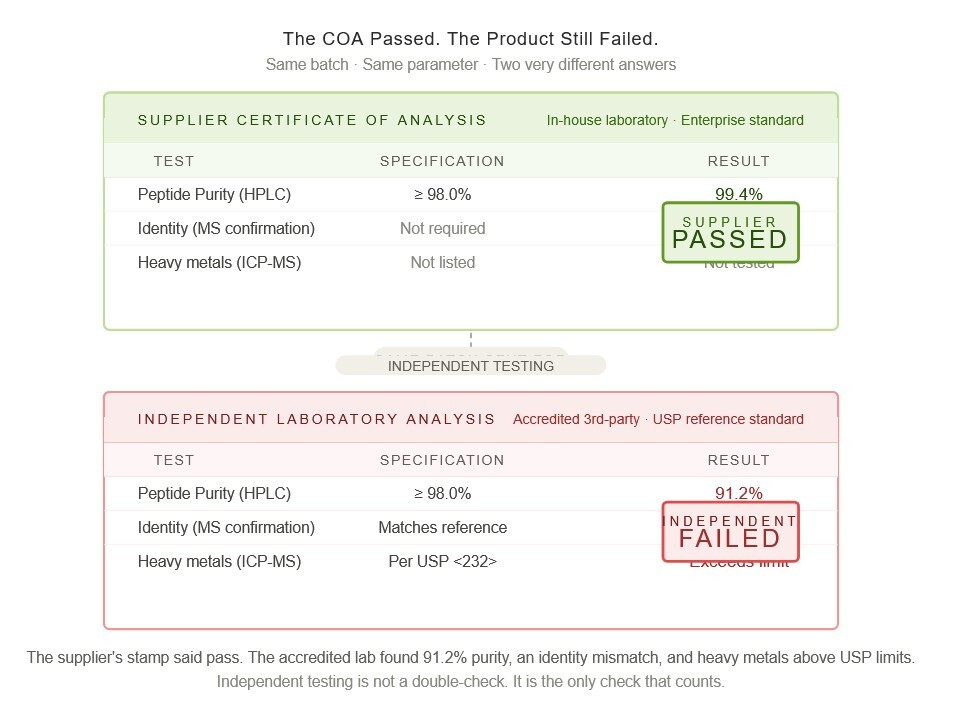
The product arrives. They test it independently. It's not what the COA said.
This happens, and it's not always fraud. Sometimes it's a batch that drifted. Sometimes it's a substitution somewhere in the chain. Sometimes the COA was genuine but described a different batch than the one that shipped. Whatever the cause, it points to the one truth this whole series has been building toward: everything upstream of the vial is a claim. Only testing the vial is proof.
Verifying the lab tells you the source is real. Reading the COA tells you what the supplier claims about the product. Neither tells you what's actually in the container that landed on your dock. For that, there is exactly one method: test the product you received.
Why Everything Else Falls Short of Proof
Walk back through the chain and notice that every link is a representation, not a measurement of your actual goods.
The supplier verification establishes that a real lab exists and can make your product. It does not establish that this specific shipment came from that lab, made to that standard, without substitution along the way. A real lab can still have a bad batch. A real lab can still source an item it doesn't make. Verification is necessary — it's just not the same as confirming the contents of your box.
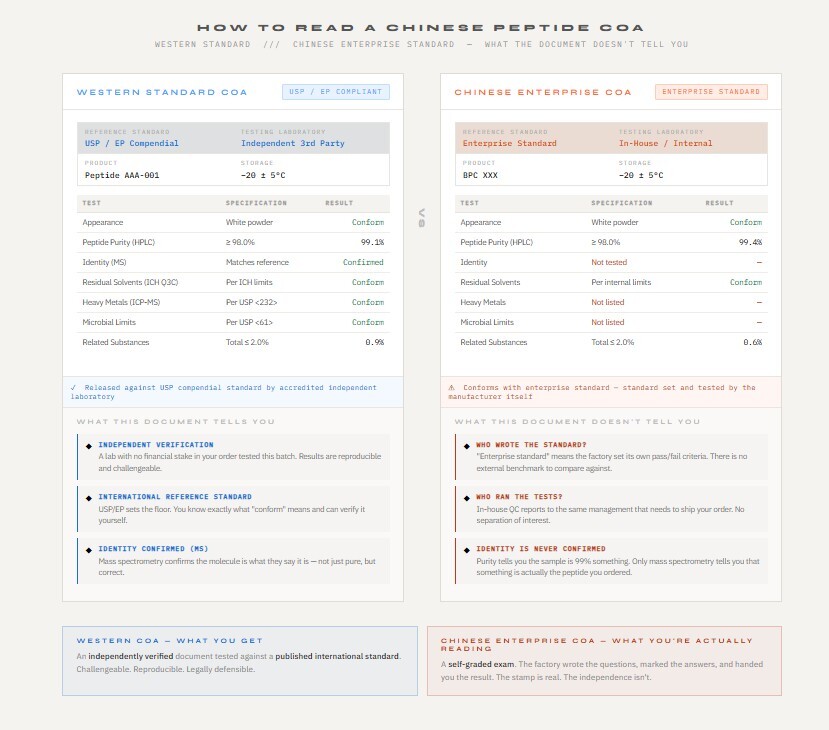
The COA is a document describing testing that was performed somewhere, at some point, on some material. Even a genuine COA with real chromatograms describes the batch it was run on — which may or may not be the batch you received. And as covered earlier in this series, COAs can be self-issued, edited, run on flattering methods, or simply not matched to your lot. The document is the supplier's claim about the product, not independent confirmation of what you hold.
The relationship, however good, doesn't change the physics. A supplier you trust, who's delivered well before, can still ship a batch that's off — through their own upstream problem, a materials issue, or a process drift they didn't catch. Trust is earned and valuable, but it's not a measurement.
Every one of these is upstream of your vial. The product in your hands is the only thing that can be measured directly, and measuring it is the only thing that closes the gap between what you were told and what you have.
What Independent Testing Actually Catches
Testing the product you received — at a lab with no stake in the answer — catches the things the upstream chain structurally can't.
The batch that drifted. A supplier's process can produce a great batch and then a weaker one. Independent testing of your actual shipment catches the drift that a prior batch's COA would never show.
The substitution. Somewhere between synthesis and your dock, the product can change — a different source, a different grade, a mix-up. Independent testing on the received goods is what surfaces a substitution that all the upstream paper would happily paper over.
The content-vs-purity gap, on your actual goods. As covered earlier, a high purity figure says nothing about how much actual peptide is in the vial versus water and salt. Independent testing of what you received measures both, on your material — not on whatever the COA was run against.
The identity problem. Independent mass spec on your actual product confirms the vial contains the peptide you ordered, not a clean sample of something else. This is the check that a purity-only COA can't give you and that matters most where products are visually identical.
The COA that doesn't match reality. When the independent test result and the supplier's COA disagree, you've learned something no amount of upstream verification could tell you: the paper and the product don't line up. That divergence is itself critical information about the supplier.
When Independent Testing Matters Most
Testing has a cost, and not every order warrants the same intensity. But there are points where independent verification of the received product earns its keep every time.
A new supplier, first order. Before you've built any track record, the received-product test is how you find out whether the supplier's claims survive contact with reality. The first order is the highest-information test you'll ever run on a new source.
A new product from an existing supplier. Even a trusted lab sources some items it doesn't make. A new product line is exactly where an otherwise-reliable supplier might be reselling rather than synthesizing. Test it like it's a new relationship, because for that product, it is.
After any signal of change. A new batch that looks or behaves differently, a sudden price shift, a change in packaging or documentation, a longer-than-usual lead time — any of these is a reason to verify the actual goods rather than assume continuity.
On an interval, for ongoing supply. Even a solid, long-running supplier relationship benefits from periodic independent testing. It confirms that consistency is holding, and it keeps the supplier aware that the product is being checked — which itself supports consistency.
The Mindset This Comes Down To
The whole series reduces to one discipline: treat every representation as a claim to be verified, and treat the product itself as the only thing that settles the question.
The listing is a claim. The COA is a claim. The supplier's reassurance is a claim. Each can be true. Each can also be wrong, drifted, or stale. None of them is the vial. In a category where the difference between what you were told and what you have can matter, the only thing that resolves the difference is measuring what you actually received.
That's not cynicism about suppliers. The best suppliers welcome it, because a supplier confident in their product has no reason to fear an independent test — and a supplier who resists one is telling you something. Independent testing isn't an accusation. It's the closing of the loop. It's the difference between believing you know what's in the vial and actually knowing.
What China Agent Does
China Agent provides supplier verification and due diligence on the ground in China. We establish whether a supplier is a real lab, whether their documentation holds up, and whether the source is durable — and we help buyers understand where independent verification of the received product fits into that picture.
We do not source, supply, manufacture, test, or transport any products. Where independent testing of received goods is warranted, we help buyers understand the role it plays and how it fits alongside on-the-ground supplier verification. Our role is to help you close the gap between what you're told and what you can confirm — so the decisions you make are based on proof, not representation.
Frequently Asked Questions
Why isn't a COA enough proof of what's in my peptide vial? A COA is a document describing testing performed on some material at some point — which may or may not be the exact batch you received. Even a genuine COA can describe a different lot, be self-issued by the supplier, run on a flattering method, or simply not match what shipped. It is the supplier's claim about the product, not an independent measurement of the goods in your possession. Only testing the product you actually received confirms its contents.
If I've verified the supplier is a real lab, do I still need to test the product? Yes. Verifying a lab is real and capable establishes that the source can make your product — it does not confirm that a specific shipment came from that lab, was made to standard, and reached you without substitution or drift. A genuine lab can still produce a weak batch or resell an item it doesn't make. Supplier verification and product testing answer different questions; both matter.
What does independent testing catch that a COA can't? Independent testing of the goods you received catches batch drift, substitutions occurring anywhere in the chain, the gap between purity and actual peptide content on your specific material, and identity problems — confirming the vial contains the peptide ordered rather than a clean sample of something else. It also reveals when a supplier's COA doesn't match the actual product, which is critical information about that supplier's reliability.
What does "independent" testing actually mean? It means testing performed by a laboratory with no stake in the result — not the supplier's own QC, and not a lab connected to the supplier. The value of independence is the absence of any incentive to produce a favorable number. A supplier testing its own product may be entirely honest, but the result carries the supplier's interest with it. An independent test measures the product on neutral ground.
When is independent testing most worth the cost? Most valuable on a first order from a new supplier, on a new product from an existing supplier (where even a trusted lab may be reselling rather than synthesizing), after any signal of change such as a different-looking batch or a price shift, and at intervals for ongoing supply to confirm consistency is holding. The first order from a new source is the single highest-information test you can run.
What should I do if the independent test disagrees with the supplier's COA? Treat it as significant information about the supplier, not a minor discrepancy. A divergence between the independent result and the COA means the document and the product don't line up — whether through batch mismatch, a flattering test method, substitution, or an inaccurate certificate. The independent test reflects what you actually have. Repeated or serious divergences are a reason to reassess the supplier relationship entirely.
Does wanting to independently test a product insult a good supplier? No. A supplier confident in their product has no reason to fear an independent test, and the better suppliers expect and welcome routine verification. Independent testing isn't an accusation — it's standard diligence that closes the gap between claim and confirmation. A supplier who resists or objects to independent testing is itself providing useful information about how much scrutiny their product can withstand.
Is independent testing necessary for every single order? Not necessarily. Testing has a cost, and a long-running, well-verified supplier relationship with consistent results may warrant interval testing rather than testing every shipment. The intensity should match the risk: highest for new suppliers, new products, and any signal of change; lighter but still periodic for established, proven supply. The principle is to verify the actual product often enough that you're confirming consistency rather than assuming it.
China Agent provides supplier verification and due diligence services for buyers importing from China. We do not source, supply, manufacture, handle, test, or transport any products. We do not provide legal, medical, or regulatory advice, and nothing in this article constitutes such advice. The legal status of any product varies by jurisdiction, and buyers are solely responsible for understanding and complying with the laws that apply to them. This content is educational and reflects our experience verifying suppliers on the ground in China.