
What "Pharmaceutical Grade" Actually Means When a Chinese Supplier Says It
The Word That Sounds Like a Standard but Often Isn't One
A supplier describes their product as "pharmaceutical grade." It sounds definitive. It sounds like the product met a recognized standard that someone official enforces. The buyer relaxes a little — pharma grade, that's the good stuff.
Then you ask the obvious question: pharmaceutical grade by what standard, certified by whom, against which monograph? And often, the answer dissolves. There's no monograph. No certifying body. No enforceable standard behind the word. "Pharmaceutical grade" was a description the supplier chose, not a standard the product met.
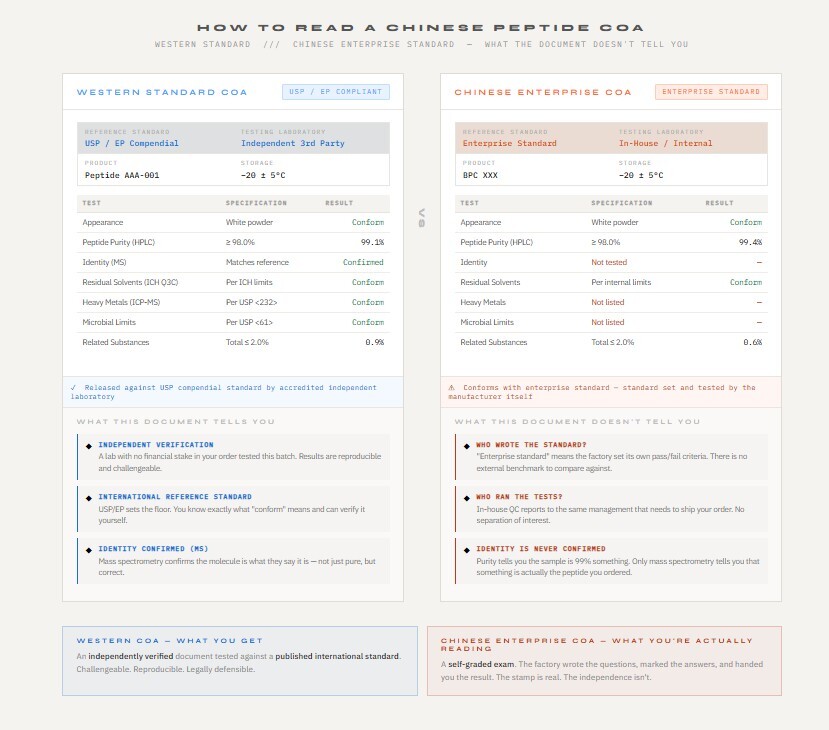
This is the third document-literacy problem in this series — after the supplier who isn't a lab and the COA that doesn't mean what you think. The grade claim is the same trap in a different form: a term that carries the weight of a standard, used in a context where no standard is being enforced. Learning to read it is learning to tell the difference between a claim and a certification.
What These Terms Are Supposed to Mean
In a properly regulated pharmaceutical context, grade terms have real definitions tied to enforceable standards.
Pharmaceutical grade, in the strict sense, means a substance that meets the requirements of a recognized pharmacopoeia — a published monograph specifying identity, purity, and the tests and limits a substance must satisfy. The standard is defined, public, and enforced by a regulatory authority.
USP grade points to the United States Pharmacopeia — a specific monograph with specific requirements that the substance must meet and that can be verified against the published standard.
Research grade or reference grade generally signals material intended for laboratory or analytical use, with its own implied expectations.
The crucial thing about these terms in their proper context is that they're anchored. There's a published standard behind them, a body that maintains it, and a way to verify whether the substance actually meets it. The term means something because something enforces it.
What Happens to the Term on a B2B Listing
On a Chinese B2B platform, the anchoring often disappears while the word stays.
A supplier can write "pharmaceutical grade" on a listing without any pharmacopoeial standard being met, certified, or even referenced. The platform doesn't verify it. No regulatory body is enforcing it. The term is doing marketing work, not certification work — it's there because it sounds reassuring and helps close the sale, not because the product was tested against a monograph and passed.
This isn't necessarily fraud. Sometimes the supplier genuinely believes their product is high quality and reaches for the most impressive-sounding term to say so. Sometimes it's a loose translation. Sometimes it's deliberate. But intent doesn't change the buyer's problem: the word on the listing is not connected to an enforced standard, so it tells you what the supplier wants you to believe about quality, not what the product verifiably is.
The same applies to "GMP" claims — Good Manufacturing Practice. GMP refers to a manufacturing quality system, and real GMP certification exists and means something. But "GMP" written on a listing, without a certificate from a recognized body and verification that it's current and covers the relevant facility and product, is again a claim wearing the clothes of a certification.
Why This Matters in This Category Specifically
In a category where products are visually identical and the buyer can't assess quality by looking, the grade claim carries more weight than it should — and that's exactly why it's risky.
A buyer who can't independently evaluate the product leans on the descriptors the supplier provides. If those descriptors are unanchored marketing terms, the buyer is making a quality judgment based on vocabulary rather than verification. "Pharmaceutical grade" becomes a substitute for actually knowing the purity, the content, and the identity — the things that a COA, properly read, and independent testing actually establish.
The grade term, in other words, can quietly replace the verification it's standing in for. The buyer feels reassured by the word and does less of the real diligence. That's the danger: not that the term is always false, but that it discourages the verification that would tell you whether it's true.
How to Read a Grade Claim
Concrete steps to turn a grade claim back into a question you can actually answer.
1. Ask "by what standard, and who certified it?" The single most useful question. A real grade claim can name the standard — a specific pharmacopoeia, a specific monograph — and point to who certified compliance. A marketing claim can't, and the answer will be vague or absent. The quality of the answer tells you which kind of claim you're dealing with.
2. Ask for the certificate, not the adjective. If a supplier claims GMP or a pharmacopoeial grade, ask for the actual certificate from the recognized body, and check that it's current, that it covers the specific facility making your product, and that it covers the product type. A real certification is a document you can examine. A real one survives that examination; a decorative one doesn't.
3. Separate the grade claim from the test data. The grade term and the actual evidence are different things. What matters is the verifiable data — the purity, the content, the identity, with the supporting chromatograms and mass spec, read properly. Treat the grade label as a headline and the test data as the substance. If the data is strong, the label is almost irrelevant. If the data is missing, the label is worthless.
4. Don't let the word substitute for verification. This is the real discipline. However impressive the grade term, it doesn't replace reading the COA properly, confirming identity, or independently testing the received product. The word should never be the reason you skip the verification — if anything, an impressive unanchored claim is a reason to verify more, not less.
The Through-Line
This piece, like the others in the series, comes down to one habit: separate the claim from the proof.
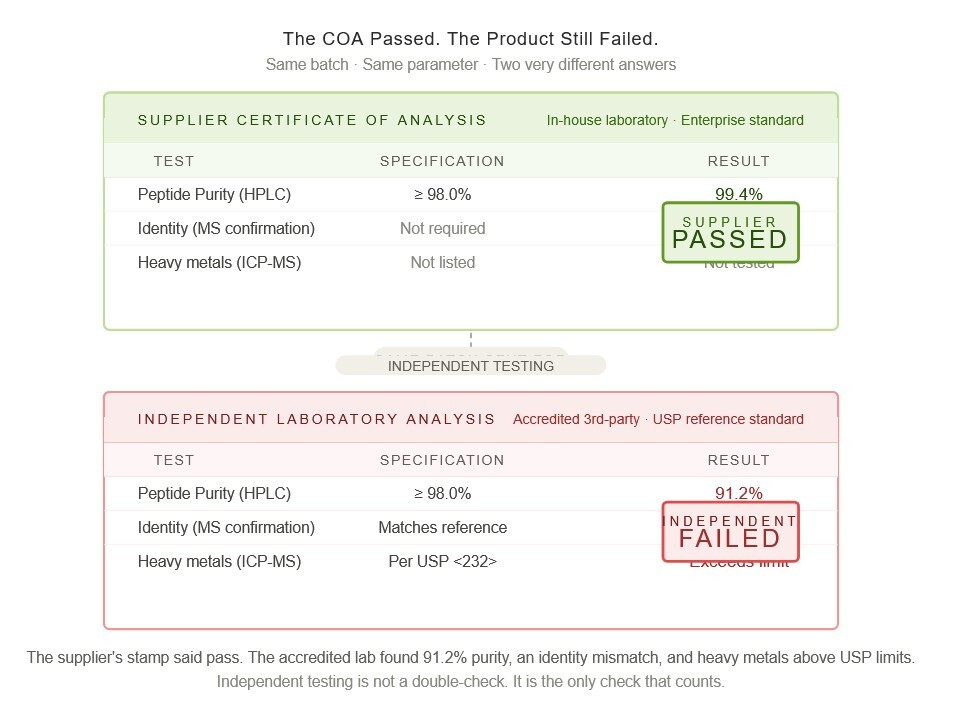
The supplier's status is a claim until verified. The COA is a claim until you read what's behind it. The grade label is a claim until someone names the standard and produces the certificate. Each of these terms is designed to feel like proof, and each can be true — but feeling like proof and being proof are different things, and the gap between them is exactly where buyers in this category get hurt.
"Pharmaceutical grade" might describe a genuinely excellent product. It might describe an ordinary one dressed up in an impressive word. The label alone can't tell you which. Only the standard behind it, the certificate that proves it, and the test data that confirms it can — and those are things you verify, not things you take on faith from a listing.
What China Agent Does
China Agent provides supplier verification and due diligence on the ground in China. We help buyers understand what a supplier's claims — including grade and certification claims — actually establish: whether there's a real standard behind the term, a real certificate behind the claim, and a real quality system behind both.
We do not source, supply, manufacture, test, or transport any products, and nothing we provide is medical or regulatory advice. What we do is help you tell the difference between a claim and a certification, verified on the ground, so the quality judgments you make rest on evidence rather than vocabulary.
Frequently Asked Questions
What does "pharmaceutical grade" actually mean? In a properly regulated context, pharmaceutical grade means a substance meets the requirements of a recognized pharmacopoeia — a published monograph specifying identity, purity, and the tests and limits the substance must satisfy, enforced by a regulatory authority. The term is anchored to a defined, verifiable standard. On a B2B listing without that anchoring, however, the term may be used as marketing language with no pharmacopoeial standard met, certified, or even referenced.
Is "pharmaceutical grade" on a Chinese supplier's listing a reliable quality indicator? Not on its own. Platforms generally don't verify the term, and no regulatory body is enforcing it on a listing. It often functions as reassuring marketing language rather than a certification against a standard. It may describe a genuinely high-quality product or an ordinary one labeled impressively — the word alone can't distinguish them. The reliable indicators are the named standard behind the claim, the certificate proving it, and the actual test data.
What's the difference between USP grade and pharmaceutical grade? USP grade points specifically to the United States Pharmacopeia — a particular set of monographs with defined requirements that a substance must meet and that can be verified against the published standard. "Pharmaceutical grade" is a broader term that, used properly, means compliance with a recognized pharmacopoeia, which could be the USP or another. Used loosely on a listing, "pharmaceutical grade" may not reference any specific pharmacopoeia at all, which is why asking which standard applies is essential.
What does GMP certification mean and how do I verify it? GMP stands for Good Manufacturing Practice, a manufacturing quality system. Real GMP certification from a recognized body means something, but "GMP" written on a listing is a claim until verified. To verify it, ask for the actual certificate, confirm it was issued by a recognized body, check that it is current, and confirm it covers the specific facility producing your product and the relevant product type. A claim without a verifiable, current, applicable certificate is decoration, not certification.
What single question best tests a grade claim? "By what standard, and who certified it?" A genuine grade claim can name the specific standard — a pharmacopoeia, a monograph — and identify who certified compliance. A marketing claim cannot, and the response will be vague or absent. The quality and specificity of the answer reveals whether you're dealing with an anchored certification or an unanchored descriptor.
Why are grade claims especially risky for products you can't evaluate by sight? When a buyer can't assess a product visually or independently, they tend to lean on the descriptors the supplier provides. If those descriptors are unanchored marketing terms, the buyer ends up making a quality judgment based on vocabulary rather than verification. The grade label can quietly substitute for the real diligence — reading the COA, confirming identity, independent testing — that would actually establish quality. The risk is that the impressive word discourages the verification that would reveal whether it's true.
Should a grade claim replace independent testing? No. A grade claim, however impressive, does not replace reading the COA properly, confirming product identity, or independently testing the received product. The grade term should be treated as a headline and the verifiable test data as the substance. An unanchored but impressive grade claim is a reason to verify more thoroughly, not less, because it indicates the supplier is comfortable using certification language without necessarily having certification behind it.