
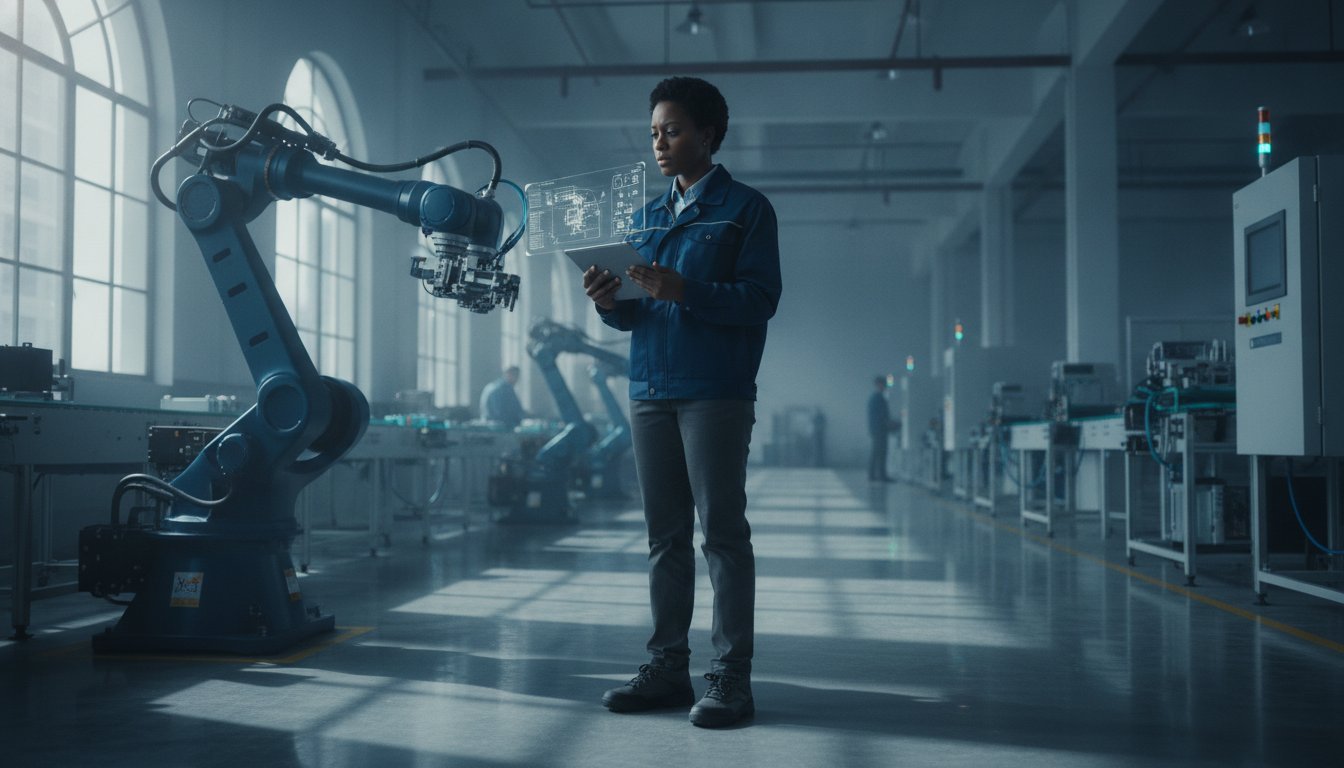

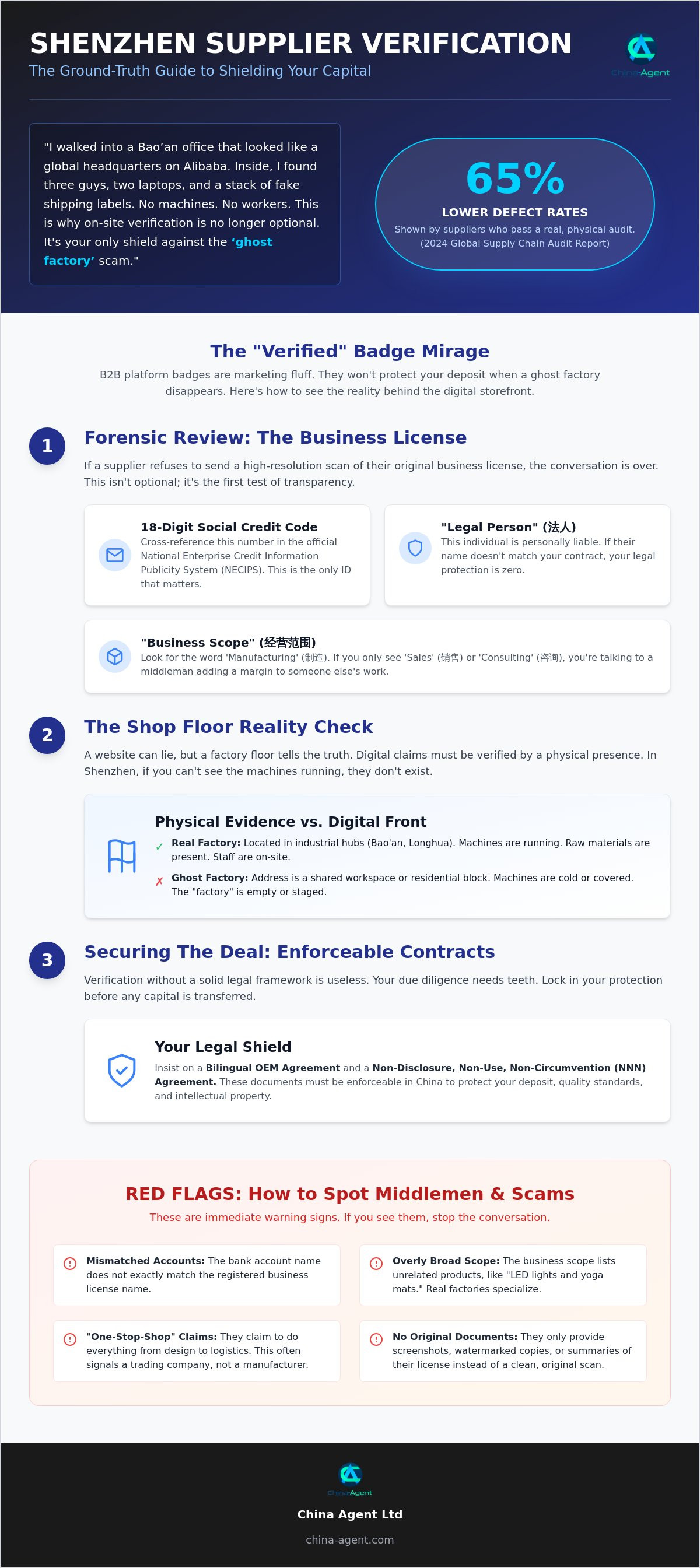
Last month, I walked into a Bao’an office that looked like a global headquarters on Alibaba. Inside, I found three guys, two laptops, and a stack of fake shipping labels. No machines. No workers. Just a "sales manager" who went silent the moment I asked to see the assembly line. This is why shenzhen supplier verification is no longer optional. It's your only shield against the "ghost factory" scam.
You're right to be paranoid about your deposit. Sending money based on a digital badge is just gambling with your company's future. This guide provides the brutal reality of the Shenzhen market so you can spot a fraud before your capital disappears. Data from the 2024 Global Supply Chain Audit Report shows that suppliers who pass a real physical audit demonstrate 65% lower defect rates. That's the only metric that matters.
I'll show you how to verify physical assets, cross-reference the 18-digit Unified Social Credit Code, and use the 2026 Commercial Mediation Regulation to get enforceable legal protection. We're moving past the marketing fluff and into the ground-truth of manufacturing.
Key Takeaways
- Stop trusting "Verified" badges on B2B platforms. They're marketing fluff that won't protect your deposit when a ghost factory goes dark.
- Conduct a forensic shenzhen supplier verification by cross-referencing the 18-digit Unified Social Credit Code against official government records.
- Look for physical evidence on the shop floor in industrial hubs like Bao'an or Longhua. If the machines are cold and the "factory" is in a residential block, it's a scam.
- Identify middlemen by checking if their bank accounts match their business licenses exactly. Real factories don't hide behind unrelated offshore entities or "one-stop-shop" claims.
- Lock in your protection with a Bilingual OEM Agreement and NNN. Without a solid contract, your verification effort has no teeth if quality drops or your IP is stolen.
The Shenzhen Mirage: Why Digital Verification Fails in 2026
I recently dealt with a client in New York who was convinced they had found a Tier-1 manufacturing partner in Futian. The website was slick. The "Verified" badge on their profile was shiny. But when I showed up at the registered address, I found a shared workspace with a receptionist who had never heard of the company. This is the "Ghost Factory" phenomenon. Shenzhen supplier verification isn't about reading a PDF or checking a box on a website. It's a forensic investigation of physical claims versus the brutal reality of the shop floor.
Shenzhen's history as the most successful of China's special economic zones created a manufacturing engine unlike any other on earth. It also created a world-class ecosystem of deception. Middlemen here are experts at targeting importers in cities like NYC or San Francisco. They know you're unlikely to hop on a 15-hour flight to verify a $50,000 deposit. They build high-end digital storefronts that look like billion-dollar enterprises, but the reality is often a guy with a laptop and a talent for Photoshop.
The 'Gold Supplier' Myth
An Alibaba Gold Supplier badge is a marketing expense, not a character reference. Suppliers pay a yearly fee for that status. It doesn't mean they're honest; it just means they're profitable enough to afford the subscription. I've seen 10-year-old accounts that were nothing more than shell companies. The "verified" videos you see on these platforms are often stock footage or filmed in a different factory entirely. If you haven't had a Supplier Reality Check™ performed on-site, you're just gambling with your capital.
Shenzhen's Unique Ecosystem of Deception
The proximity of Huaqiangbei's massive component markets to the assembly lines in Bao'an makes it easy to fake manufacturing scale. I once tracked a "factory" to a rented warehouse in a back-alley. Inside, five temporary workers were hand-soldering boards on wooden tables. They weren't a manufacturer. They were a trading company buying factory rejects, cleaning them up, and shipping them as "A-grade" stock. They posed as a factory to inflate their margins and hide the fact that they had zero control over quality. In Shenzhen, if you can't see the machines running, they don't exist.
Step 1: Forensic Review of the Shenzhen Business License
I was at a Longhua factory last week. The sales rep handed me a business license that looked perfect. It had the red seal. It had the correct address. Then I ran the 18-digit Unified Social Credit Code through the official government system. The company had been blacklisted for "abnormal operations" three months prior. This is why shenzhen supplier verification starts with paper but ends with cold, hard data. If a supplier refuses to send a high-resolution, original scan of the 'Business License of the Enterprise Legal Person,' I stop the conversation. There's no second chance for transparency.
You can't trust a digital summary. You need the raw document to verify the "Legal Person" (法人). This individual is personally liable for the company's debts. If the name on the license doesn't match the name on your contract, your legal protection is zero. The complexity of these documents is part of , where a shell company registered in a residential apartment looks identical to a high-tech manufacturer on a laptop screen.
Decoding the Unified Social Credit Code
The 18-digit code is the only ID that matters. Digits 9 through 17 represent the Organization Code. I use the National Enterprise Credit Information Publicity System (NECIPS) to cross-reference this number. If the registration authority isn't the Shenzhen Market Supervision Administration, you're likely dealing with an out-of-province middleman posing as a local factory. Don't take their word for it. Check the database yourself or use a professional due diligence service to pull the full history.
Red Flags in the Scope of Business
The "Business Scope" (经营范围) tells you exactly what the government allows them to do. Look for the word 'Manufacturing' (制造). If you only see 'Sales' (销售) or 'Consulting' (咨询), you're talking to a middleman. They're just adding a 20% margin to someone else's work. A real factory is specialized. If their scope includes everything from LED lights to yoga mats, they don't own a single machine.
Pay attention to the Registered Capital. As of 2026, the 5-year capital injection rule is strictly enforced for Shenzhen companies. This means investors must actually pay that capital into the bank. If a company claims 10 million RMB in capital but has a history of legal disputes over unpaid bills, that money doesn't exist. It's a paper shield. Always verify the 'Export License' (出口许可) status as well. If they can't export directly, they're using a third-party agent, which adds another layer of risk to your money.
Step 2: The Shop Floor Reality Check – What I Look for on the Ground
I once walked into a "clean room" in Bao’an where the workers wore brand-new lab coats with the fold creases still visible. They held soldering irons like they were foreign objects. This is the "Shenzhen Pivot." A trading company rents a floor in a real factory for 48 hours to host an audit. If you don't know what to look for, you’ll sign the contract and send the deposit before those lab coats are even returned to the rental shop. Effective shenzhen supplier verification requires looking past the performance.
I use the "Dust Test." If a supplier claims they're at 90% capacity, I check the machines. If the cooling vents are cold and the workspace is too quiet, they’re lying. Real factories are messy, loud, and smell like industrial oil. I look for "Work in Progress" (WIP). If the bins are full of parts for a completely different product than what you discussed, you’re looking at a sub-contractor’s floor. If the "Boss" giving you the tour doesn't get a nod of recognition from the line workers, he doesn't own the place. He's a guest.
The 'Staged Factory' Detection
Check the employee break room. Does it look lived-in? Are there personal items, half-empty water bottles, or signs of a lunch shift? I once found a "factory" where the machines weren't even plugged into the wall. The cables were coiled neatly behind the benches. They had set the stage for my visit, but they hadn't actually produced a unit in months. If you want to see the truth, you need a Guided Visit that skips the boardroom and goes straight to the loading dock.
District-Specific Verification in Shenzhen
Bao’an and Longhua are the heart of electronics manufacturing. If your supplier is registered there but the "factory" address is a residential tower in Futian, it's a scam. It is common for a Shenzhen company to have its main factory in Dongguan for lower land costs. This is a valid setup, but you must verify the landlord. I check the lease agreements. If the supplier is a sub-leaser with a month-to-month contract, they can vanish overnight with your deposit.
Look at the QC stations. Are the testing jigs actually plugged in? Are the logbooks filled out with varying handwriting over the last six months, or were they all written this morning by the same person? I’ve seen "functional" QC stations that were just empty plastic shells with blinking LEDs. A Supplier Reality Check™ identifies these props before they cost you your business. If the safety equipment is covered in a layer of undisturbed grime, they don't value their workers, and they won't value your product quality.
Avoiding the Trading Company Pivot: Identifying Middlemen
I once audited a "specialized" electronics factory in Longhua that was pitching a high-end audio project. When I looked at their showroom catalog, they were offering wireless earbuds, silicone kitchenware, and electric scooters. I asked the sales manager how one assembly line handled liquid silicone injection and PCB SMT. He gave me a blank stare. This is the 'One Stop Shop' trap. No real factory in Shenzhen is that diverse. If they claim to make 500 unrelated products, they don't make any of them. They're a trading company. They're siphoning your margin while adding zero value to the quality. Effective shenzhen supplier verification means knowing when a catalog is too good to be true.
Traders fight tooth and nail to keep you away from the shop floor. They’ll offer "convenient" meetings in Futian coffee shops or fancy showrooms. They know that a real physical inspection would expose them as a middleman with a laptop. They are protective of their "source" because that's their only asset. If you can't walk the line, walk away from the deal. You can see how our Supplier Reality Check™ exposes these pivots before you sign.
The Name Matching Game
Check the bank account name. It must match the business license exactly. If your invoice says "Shenzhen [Brand Name] Electronics" but the bank account is a "Hong Kong Offshore" entity or a different company name entirely, you're in the danger zone. Factories in Shenzhen have local RMB and USD accounts tied to their physical location. Offshore accounts are often used by traders to bypass taxes or hide their identity. I also cross-reference the Legal Representative’s name across other business records. If the "Boss" is also the legal rep for six other unrelated trading firms, he's a professional middleman; he isn't a manufacturer.
The Sample Test
I use a specific trick to flush out traders. Request a custom sample with a technical, non-standard modification. Ask for a specific PCB trace change or a non-standard material density. A real factory engineer will tell you why it’s difficult, expensive, or requires a new mold. A trader will say "no problem" immediately. They don't understand the manufacturing friction. They just want the sale. They’ll say yes to everything, then disappear when the actual factory tells them it’s impossible. Read more about the Verify Factory Ownership in China dynamic to understand why the 'Sales Manager' usually isn't who they claim to be.
If you suspect you're being played by a middleman, get a Fixer Service to verify the ground-truth immediately.
Securing the Deal: From Verification to Enforceable Contracts
I’ve stood in the lobby of the Shenzhen Intermediate People's Court watching an importer realize his $200,000 contract was garbage. He had a 40-page document written by a New York lawyer. It was beautiful. It was also useless. The Chinese entity name was wrong, and there was no official company chop. In this city, shenzhen supplier verification is only the first half of the battle. If you don't lock that verification into a Bilingual OEM Agreement, you haven't bought security. You've just bought a story.
The rules changed in 2026. With the new Commercial Mediation Regulation that took effect on May 1, 2026, and the Arbitration Law updates from April 2026, you actually have teeth in a dispute. But only if your contract is valid under Chinese law. A US-based contract is a paper tiger. If you can't sue them in Shenzhen, you can't sue them at all. I never let a client send a cent until they have a physical audit report in their hands and a signed NNN Agreement to protect their IP. Anything less is professional negligence.
The Enforceability Gap
Shenzhen courts generally ignore contracts that aren't in Chinese or don't specify local jurisdiction. To survive, your deal needs three mandatory clauses. First, the Chinese version must be the governing language. Second, the jurisdiction must be a local court or a recognized Chinese arbitration commission. Third, you must include specific liquidated damages. If the factory misses a deadline or fails a QC check, the penalty must be automatic and clear. For a deeper look at the legal standing of your partner, use a Due Diligence service before the ink dries.
Next Steps for Importers
Don't manage a Shenzhen supply chain from a desk in San Francisco. If you want the truth, book a Guided Visit. I’ll take you past the showroom and into the back rooms where the real work happens. Once the production starts, use Monthly Support to keep a set of eyes on the line every single week. It prevents "quality fade" and keeps the "Boss" honest.
If you've already sent a deposit and the supplier has gone dark, you need a Fixer Service to walk into their office and demand an answer. I've seen it happen too many times. A $500 audit saves a $50,000 disaster every single time. Get the boots on the ground. Get the contract right. Secure your business.
Stop Gambling and Start Verifying
Digital trust is a mirage in the Bao’an back-alleys. If you haven't seen the machines running or verified the landlord's lease, you're just betting on a website. Real manufacturing is loud, messy, and legally complex. You need to move past the "Gold Supplier" badges and into the raw data of the National Enterprise Credit Information Publicity System. Rigorous shenzhen supplier verification is the only way to ensure your capital doesn't vanish into a shell company's offshore account.
I’ve been on the ground in China since 2009. My team and I take zero commissions from factories. We work exclusively for you. We provide fixed-fee productized services so you never deal with hidden costs or middleman markups. You've spent months developing your product. Don't lose it all in a single wire transfer to a ghost factory. Take control of your supply chain today.
Get a Supplier Reality Check™ before you send your next deposit
The Shenzhen market is brutal, but it's also where the world's best hardware is made. Get the ground truth, secure your contracts, and build something that lasts.
Frequently Asked Questions
Is a Shenzhen supplier's Alibaba Gold status a guarantee of legitimacy?
No, Alibaba Gold status is a paid membership, not a certification of honesty. I've walked into "10-year Gold" offices in Futian that were just three guys in a shared workspace with zero machines. It proves they have a marketing budget, nothing more. Real shenzhen supplier verification requires looking at the assembly line, not a digital badge you can buy with a credit card.
How can I verify a Shenzhen factory address without visiting China?
You can't be 100% certain from a desk in NYC, but you can start with the National Enterprise Credit Information Publicity System (NECIPS). Cross-reference their registered address with satellite imagery. If the address points to a residential high-rise or a shopping mall, they aren't a manufacturer. Real factories are in industrial zones like Bao'an or Longhua, not luxury apartments.
What is the difference between a Shenzhen trading company and a manufacturer?
Manufacturers own the machines and have specialized business scopes. Trading companies have catalogs with 500 unrelated products. If a supplier offers you LED lights, yoga mats, and power banks, they're a trader siphoning your margin. Check the "Business Scope" on their license; if it doesn't say "Manufacturing" (制造), they're just a middleman.
Can I trust a Chinese business license sent via email?
Never trust a PDF alone. I've seen "original" scans where the red seal was clearly photoshopped onto a stolen document. You must take the 18-digit Unified Social Credit Code from that license and verify it against live government records. If the data on the screen doesn't match the paper in your inbox, stop the deal immediately.
How much does a professional Shenzhen supplier verification audit cost?
Industry rates for on-site audits depend on the depth of the investigation and the factory's location. A basic capability audit is a small fraction of the cost of a lost deposit. It's an insurance policy. Spending a few hundred dollars to verify physical assets saves you from losing fifty thousand to a ghost factory scam.
What should I do if a Shenzhen supplier refuses an on-site inspection?
Walk away and don't look back. A refusal is the loudest red flag in the industry. Legitimate factories are proud to show off their production lines to serious buyers. If they block your visit, they're either hiding a massive middleman markup or the factory doesn't exist at all.
Is it normal for a Shenzhen factory to have a Hong Kong bank account?
It's common for trading companies, but it's a massive risk for you. A real mainland factory should have a local USD or RMB account that matches their business license name exactly. If you send money to a Hong Kong offshore account, you lose your legal leverage in a Shenzhen court if the quality fails.
How do I check if a Shenzhen company has been involved in legal disputes?
Search the NECIPS database for "abnormal operations" or "serious violations." You can also check the official court records for past judgments. If a supplier has a history of unpaid bills or contract breaches, they'll treat your order the same way. I always check these records before I even step foot on their shop floor.
Disclaimer
China Agent provides supplier verification and due diligence for businesses importing from China. We do not source, supply, manufacture, test, or transport any products, and we are not a middleman. Nothing here is legal, financial, customs, medical, or regulatory advice. This content is general and educational and reflects our experience on the ground in China. Laws, tariffs, and the legal status of any product vary by jurisdiction and change over time — you are responsible for complying with the rules that apply to you. For decisions with legal or financial consequences, consult a qualified professional.